How is summer progressing for everyone? I hope you enjoyed the summer solstice with good weather and family time. Those of you in some parts of Alaska, Canada, Sweden, and Finland have “midnight sun,” so you can play games all day and night!This week, we’re going to focus on a multiplication card game. This game�, Slide-A-Thon Solitaire, is a game that pretty much everyone can play. As long as you can read numbers, you can join in on the fun.
Slide-A-Thon Solitaire is taken from Math Card Games by Dr. Joan A. Cotter and is game number P9. In this game, two sets of multiples will be sorted into order. This is definitely a game of skill. Since it is always possible to win, persistence will pay off.
Remember the sliding puzzle game that looked like this?
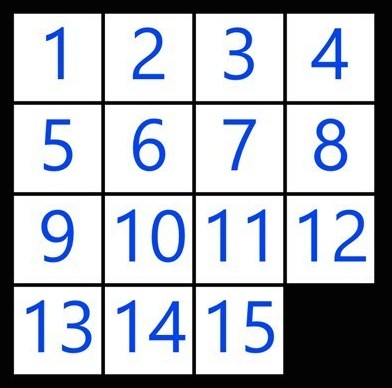
Well, that’s the concept of this game. We are going to use two sets of multiples, start with them all mixed up, then slide them into order with the one multiples set in the top two rows and the other set in the bottom two rows.
Here, let me show you what I mean. Let’s use the 5s and 8s. Of course, you can use any two sets you like, but we’re going to use 5s and 8s now. We’ll need the ten multiples of 5 (5, 10, 15, 20, 25, 30, 35, 40, 45, and 50) and the ten multiples of 8 (8, 16, 24, 32, 40, 48, 56, 64, 72, and 80). That’s twenty cards altogether. If you have the Multiplication Cards, you’re ready to play. If you don’t have this card deck, you can make your own cards using index cards.
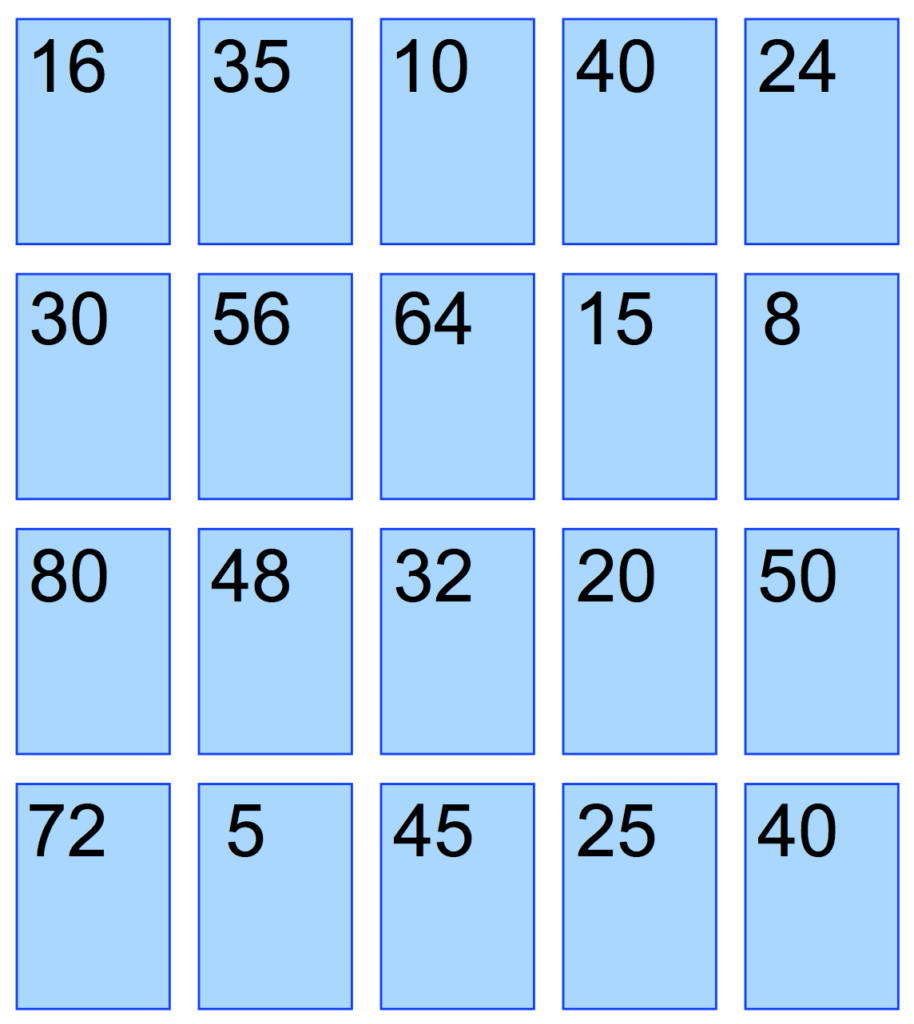
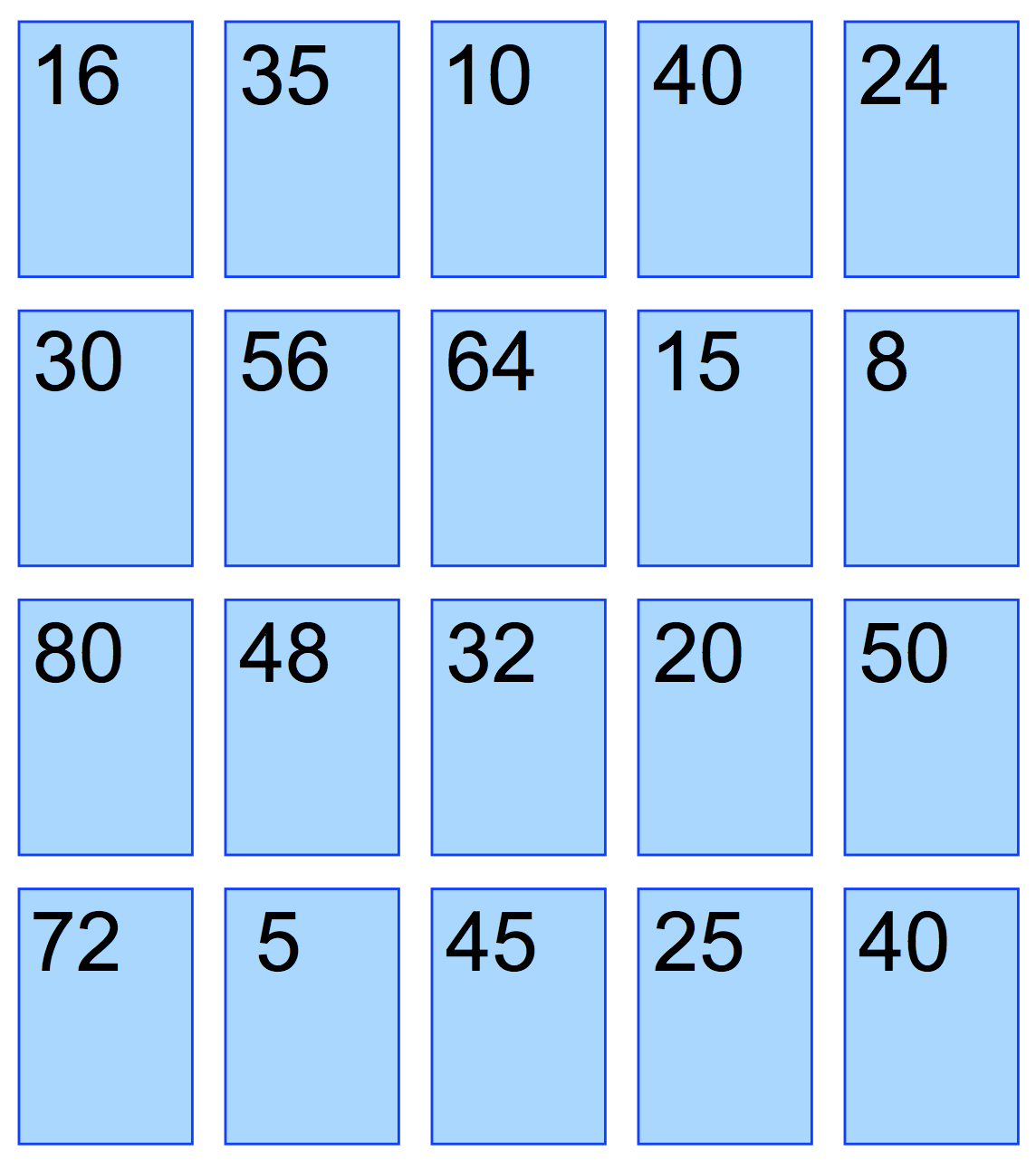
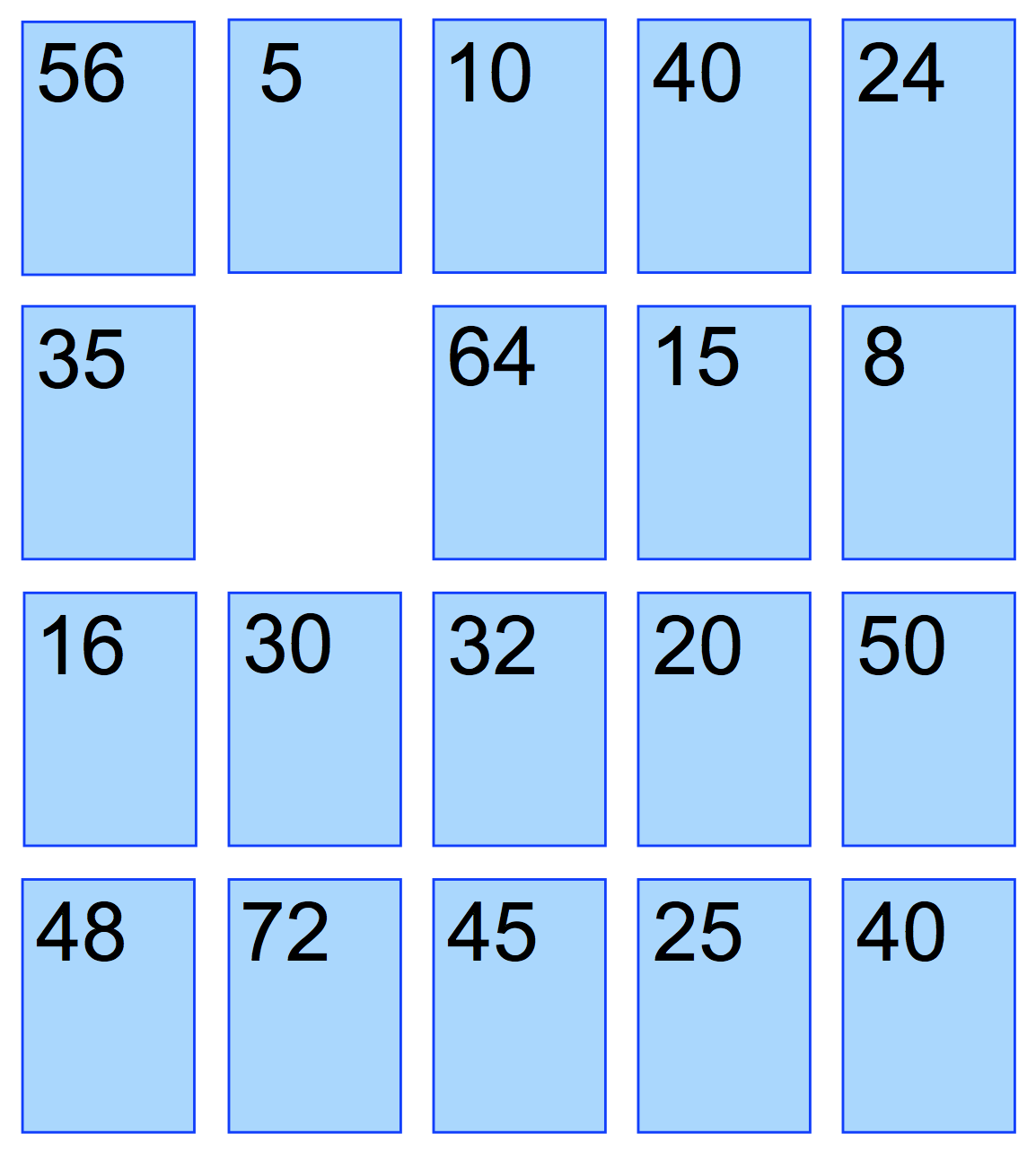
We’re going to shuffle our two sets of ten cards together, then lay them down randomly in a five by four grid. Here’s what my initial cards look like. Of course, each shuffle and starting arrangement will vary.
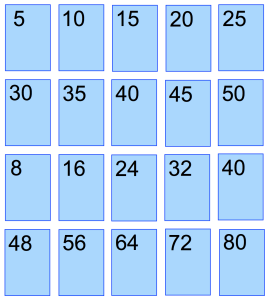
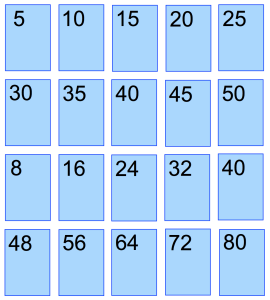
Our goal is to get the cards sorted into this final pattern! See how the 5s are on the top two rows and the 8s are on the bottom two rows and everything is all in order? That’s our goal.
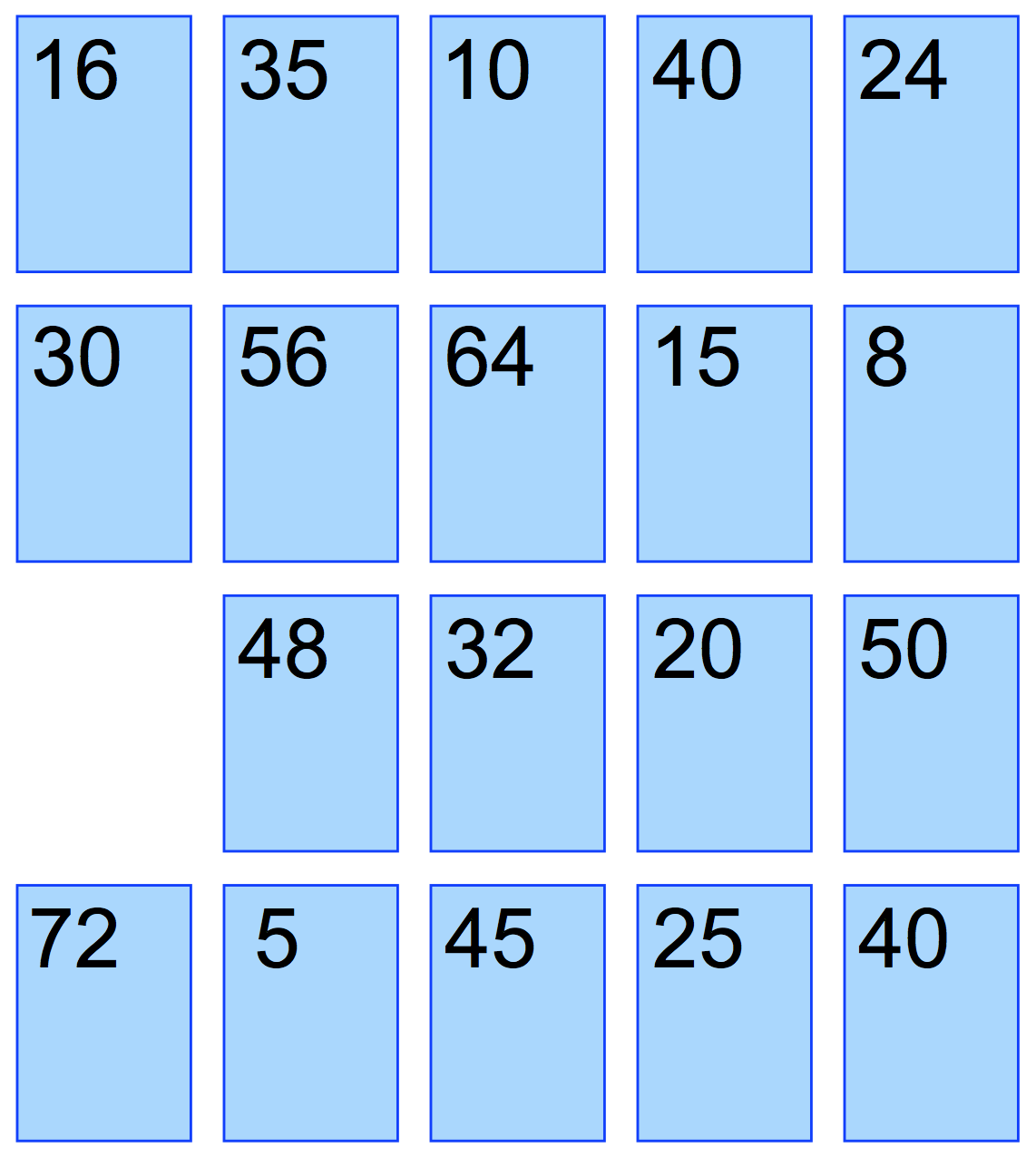
So, once we have our cards laid out in random order, we want to find the highest card, 80 in our game here. Take that card and set it aside. This creates a gap into which a neighboring card can slid into, keeping the five by four grid layout as we slide the cards around.
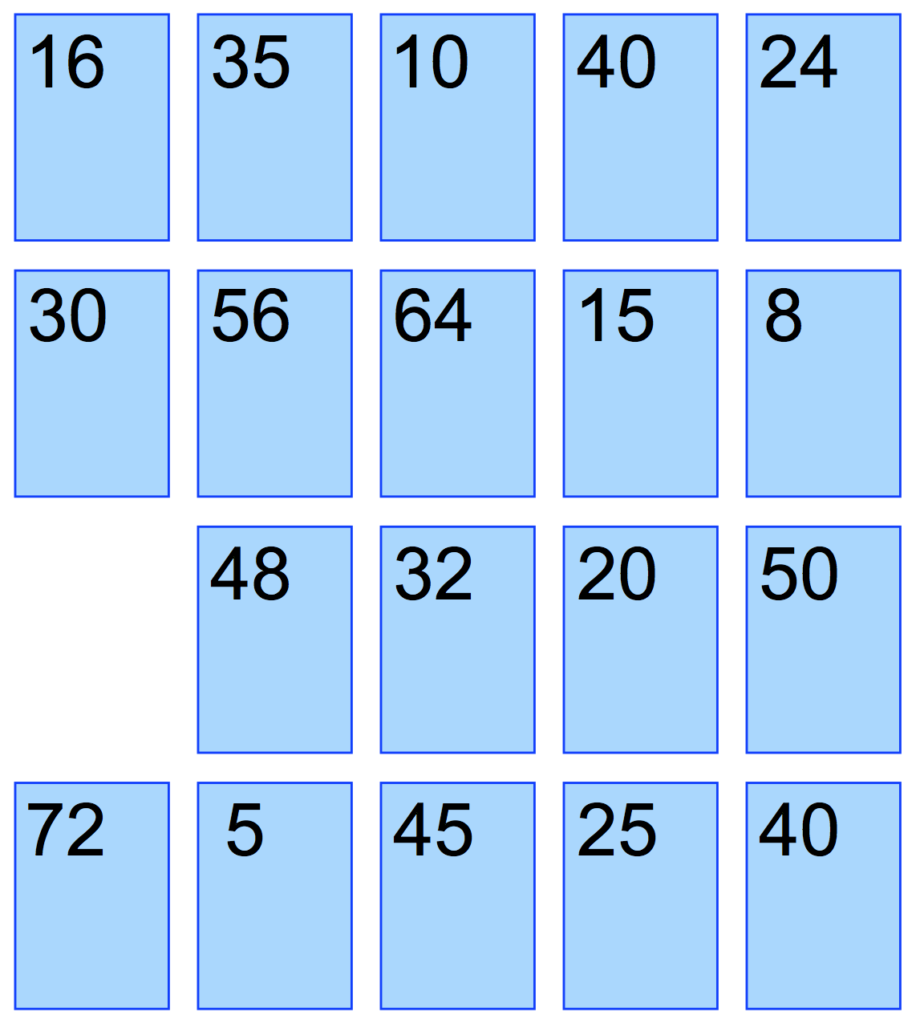
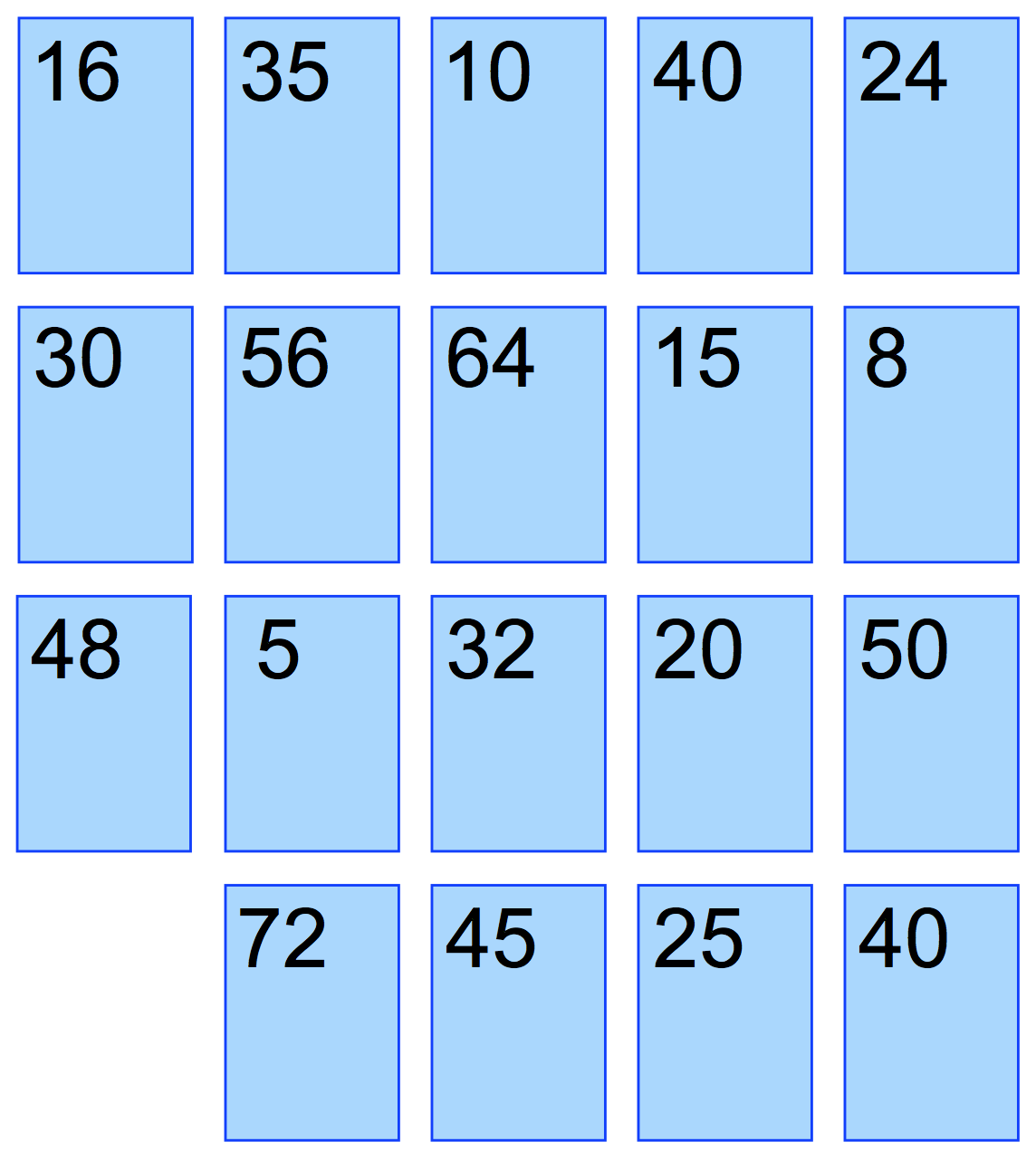
Let’s see what we can do to get things in order….Personally, I like to start at the top, so I’m going to work to get that 5-card on the bottom row up to the top left corner. Let’s slide the 48-card to the left and the 5-card up one space. Slide the 72-card to the empty spot on the right.
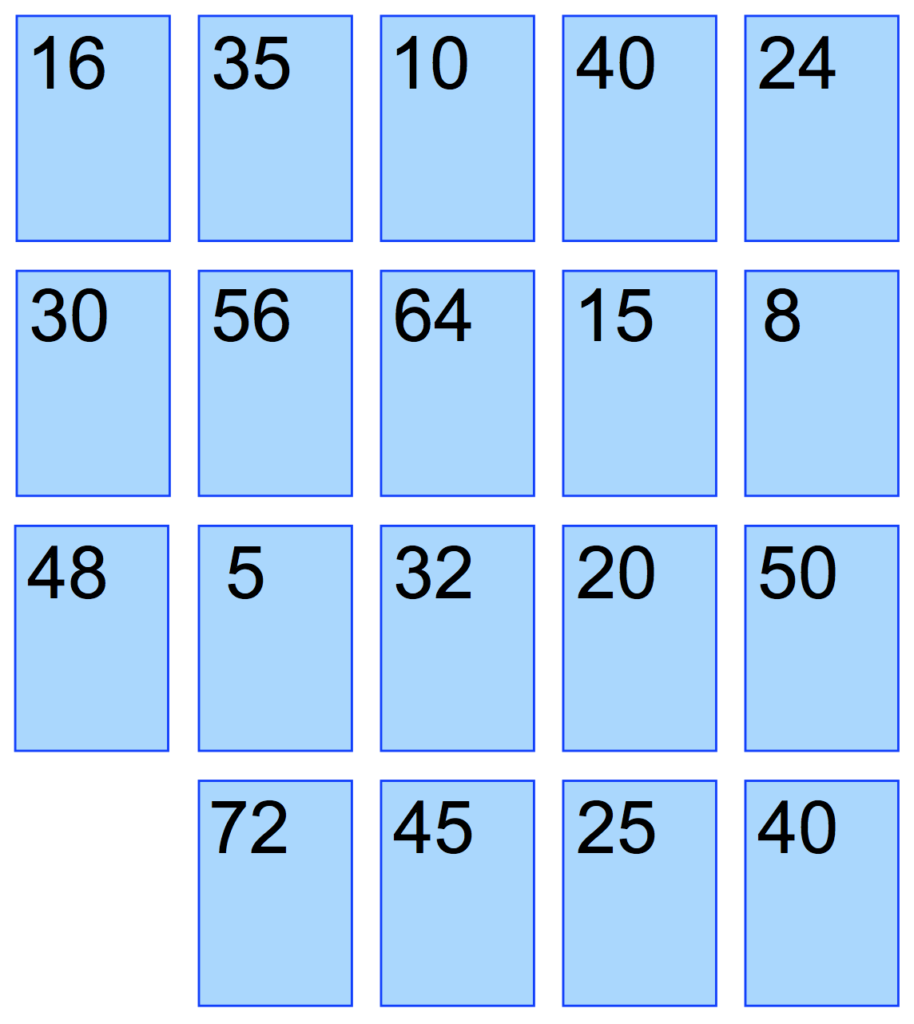
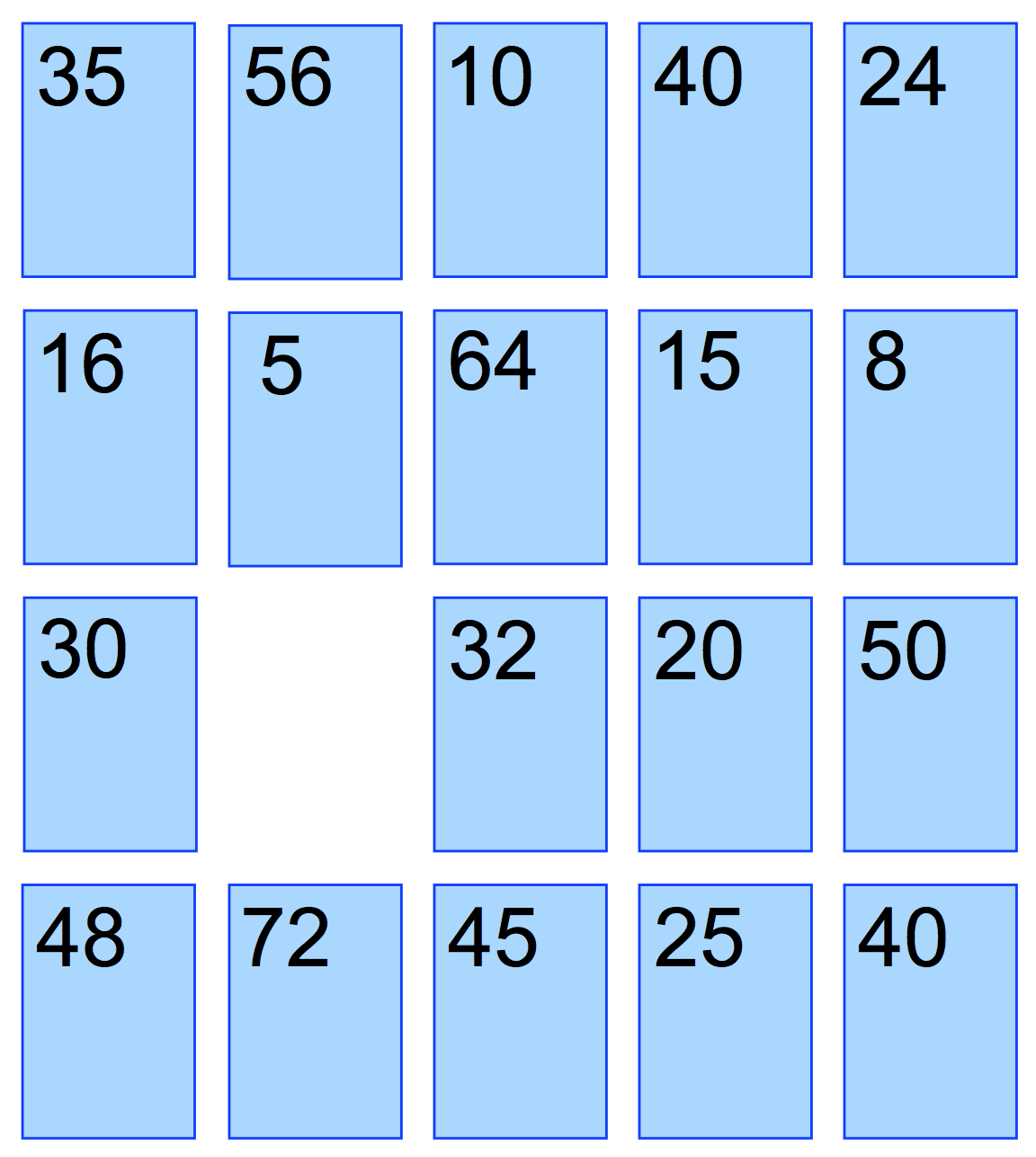
Now let’s send the 48-card, 30-card, and 16-card down, then scoot the 35-card to the left. Move the 56-card and our target 5-card up.
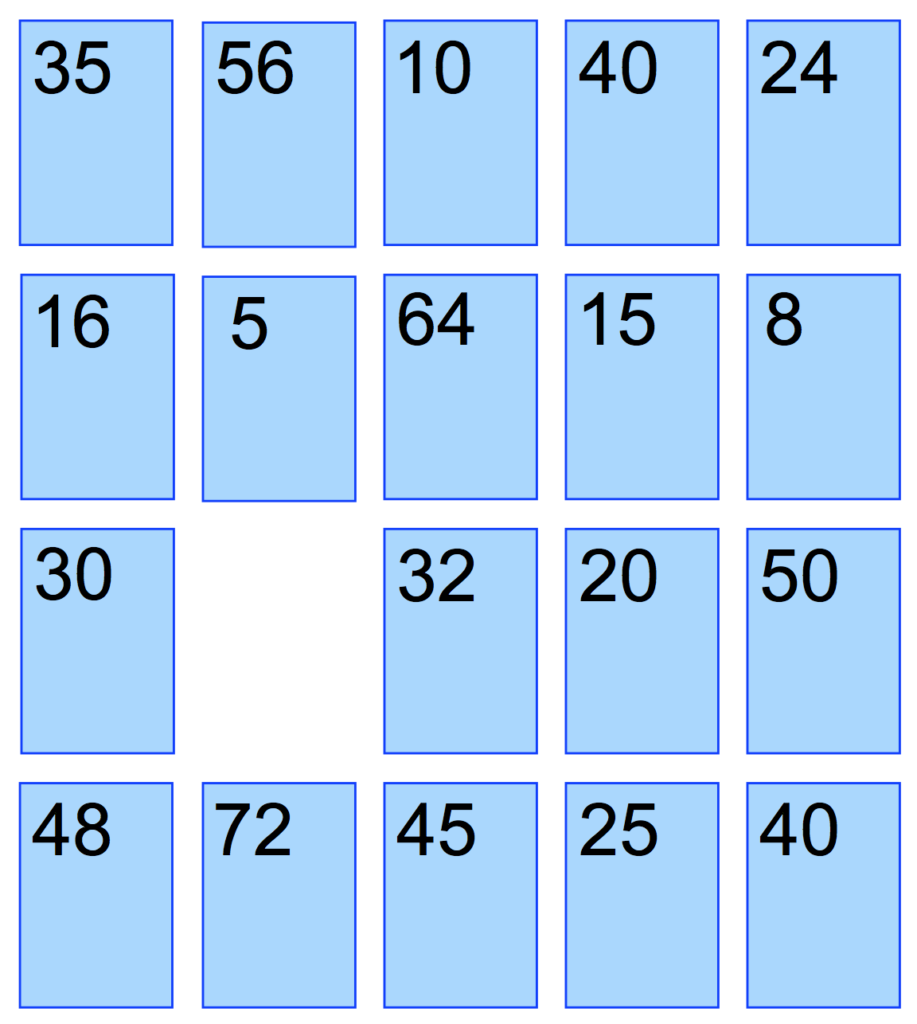
Then move the 30-card to the right, the 16-card and 35-card down, and the 56-card to the left. The 5-card goes to the top row.
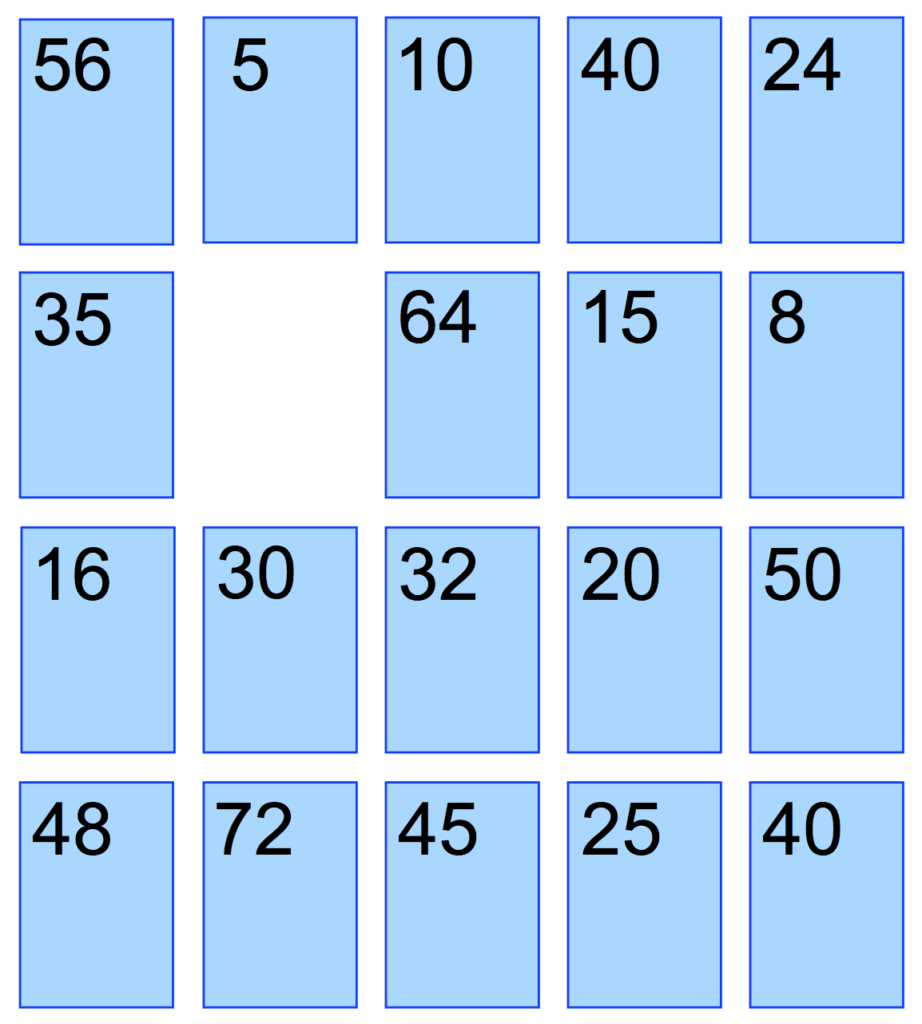
Keep sliding the cards around using the empty spot to get the cards in the right order. When you need to keep several cards in order while doing further work in a row, slide the left card down to the next row and slide the other cards to the left, creating a work area. If you end with the last two cards reversed, work to interchange any two identical cards, the 40-cards in our game.
Once all the cards are in place, put the high card back in place and it’s done!
To help a child who’s not quite good at the multiples, use a multiplication table, Cotter Abacus, or multiplication card envelopes. Don’t worry about these things becoming a crutch. This allows the child to see the multiple numbers, then create a visual image of these numbers in their memory after repeated use.As you play this week’s game, notice how many times you review the multiples of 5 and 8. Most of us have the 5s down, yet many struggle a bit with the 8s. Did you find your knowledge of the 8s a little more solid after the game? I know I did!
Remember, when you are playing math card games, there are three important things happening. First, we’re having fun with math! Second, the repetition that is needed for knowledge of the math facts is built right in. Last, and perhaps the most important, the players are applying the math they have learned in an enjoyable setting.
We will see you next week with a new game. Have a great day and go play a math card game! Keep in touch…..

2 Comments
Catherine
Was going to look through the MCG book for a multiplication game today but didn’t need to thanks to your suggestion. We haven’t played this one yet, so off we go! Thanks for the idea and the weekly newsletter. Loving both.
Jill
I wonder if this game would be best played on carpet or the table.
Sometimes the cards are hard to pick up without bending them, but my daughter would be frustrated if the cards got bumped while moving them around and her perfect pattern was askew. Maybe we can work something else out, but I do like the idea behind this one!
Comments are closed.