
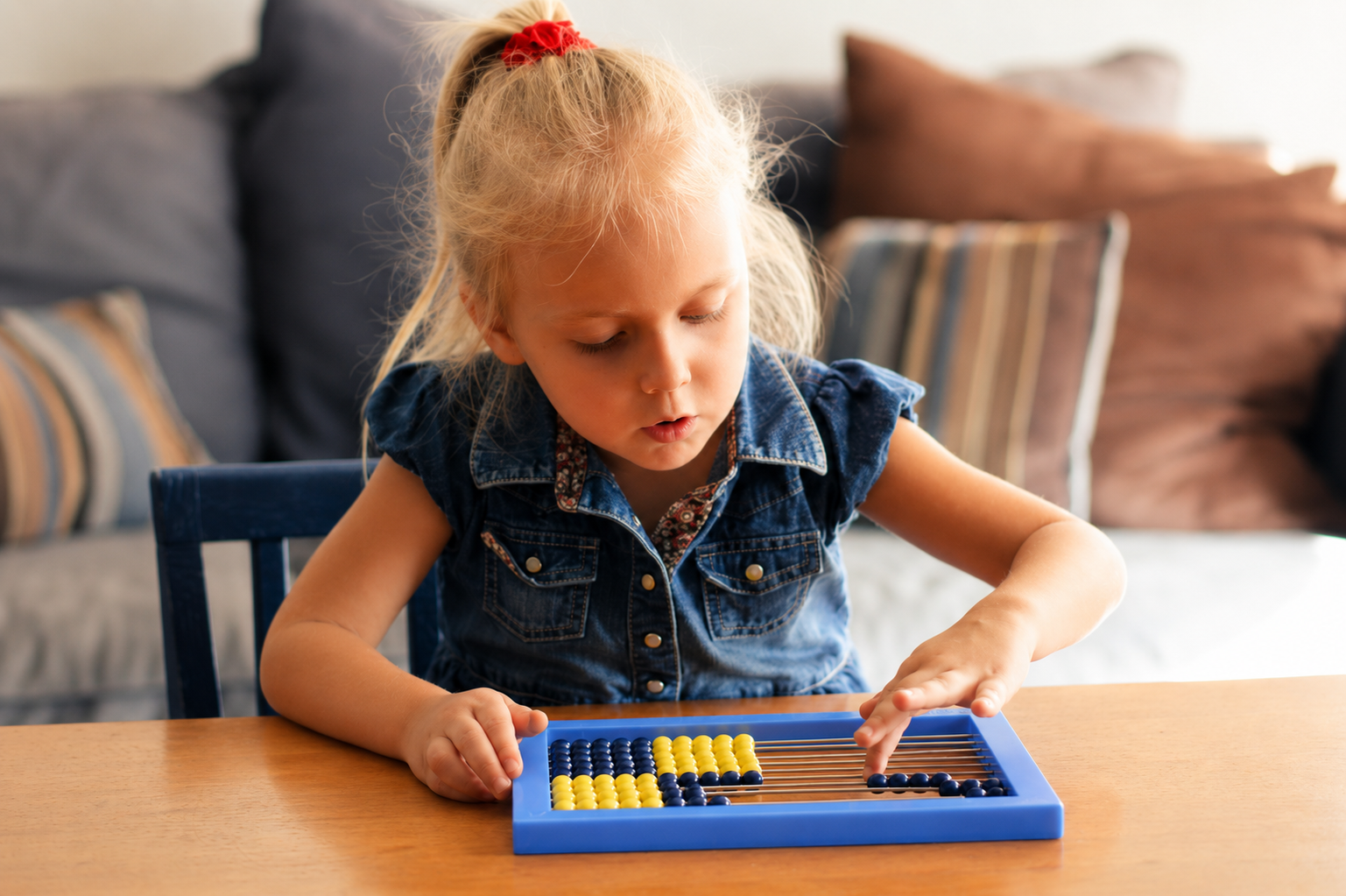
What if one of the most important math skills your child can develop begins with simply looking at a group of objects and knowing how many are there—without counting?
That skill is called subitizing (pronounced SOO-bih-tigh-zing), and it is a foundational part of number sense. While the word may be unfamiliar to many parents and teachers, the concept is surprisingly simple. Your child already uses subitizing when they look at the dots on a die and immediately know it shows 5, or when they glance at a group of three crackers and know there are three.
At RightStart Math, subitizing is much more than a fun little skill. It is one of the building blocks for developing mathematical understanding, visualization, and efficient strategies.
What Exactly Is Subitizing?
Subitizing is the ability to recognize a quantity quickly and accurately without counting the individual objects. Researchers describe it as the direct perception of how many objects are in a small group.
If you see this:

you probably don’t think, “One, two, three.” You simply see three.
That’s subitizing.
Counting, on the other hand, requires your attention to move from one object to another: “One, two, three, four…” The focus when counting is on the individual parts, not the whole. Subitizing allows a child to see the whole quantity and the individual parts at the same time.
And this distinction matters.
Why Does Subitizing Matter?
Subitizing helps children develop number sense—the ability to understand numbers, quantities, relationships, and how numbers work together.
A child who sees 5 as a recognizable quantity doesn’t have to rebuild the number, starting from 1 each time. Five becomes an idea that can be visualized.

That understanding becomes especially powerful when children begin working with larger quantities.
For example, consider 8.
A child who has to count every object will see:

and count, “1, 2, 3, 4, 5, 6, 7, 8.”
But a child who groups the objects sees 5 and 3 more, which is 8.

The child isn’t simply counting eight objects. They are seeing the structure of eight.
This is why RightStart Math emphasizes grouping in fives and tens. The RightStart approach uses the Cotter Abacus, whose beads are organized in groups of five and ten, making these quantities visually apparent.
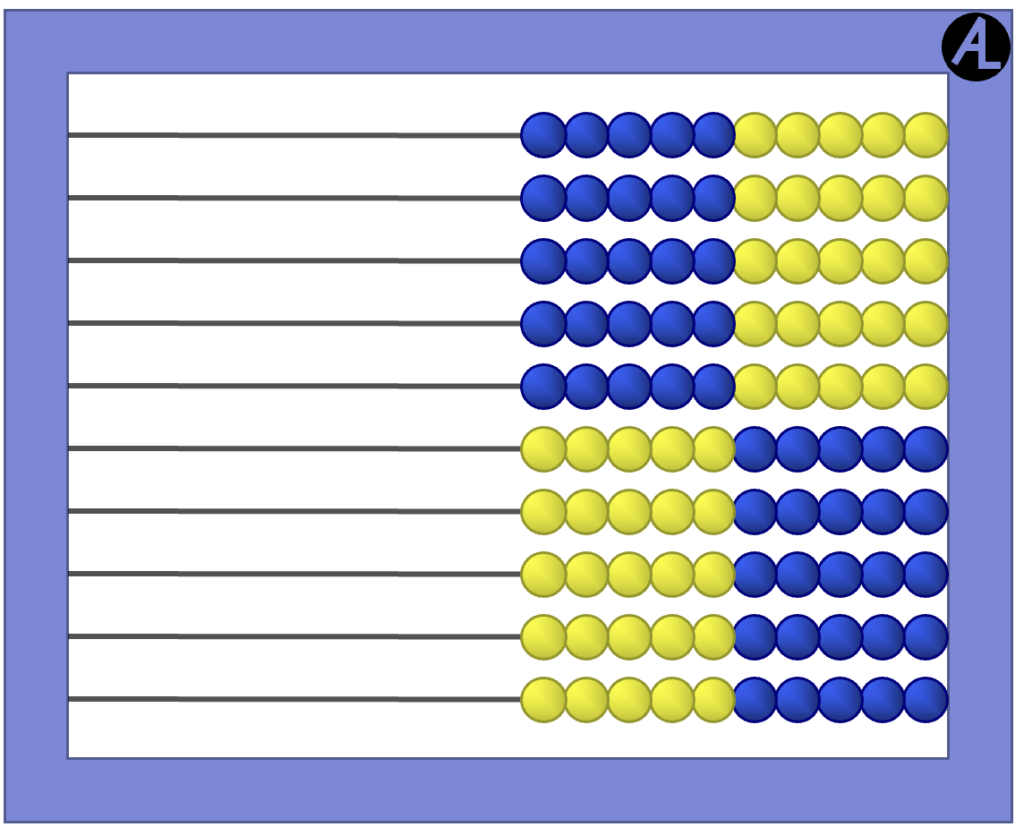
The curriculum specifically connects grouping in 5s and 10s with developing and using subitizing.
Research supports the importance of this kind of development. Subitizing has been studied as an important cognitive process in early number development, and researchers Clements, Sarama, and MacDonald argue that it deserves greater attention in mathematics instruction.
Subitizing Is More Than “Knowing the Number”
One of the most important reasons to develop subitizing is that it changes the way we think about quantities.
Imagine asking your child to visualize eight apples. If the apples are simply scattered randomly, it is difficult to be certain of the quantity, never mind to visualize, or hold, that entire quantity in the mind.

But if the eight apples are organized as five and three, the quantity becomes much easier to see and remember.

This is the connection between subitizing and visualization.
RightStart Math builds mathematics around visualization because children need to eventually be able to think about quantities when the objects are no longer physically in front of them. The curriculum uses the Cotter Abacus and other visual models to help children move from seeing and touching quantities to visualizing them mentally.
That progression is powerful:
See it → Understand it → Visualize it → Use it
And it can eventually lead to efficient and effective mathematical strategies.
Subitizing Supports Addition and Subtraction
Consider the problem 7 + 3. A child who relies heavily on counting might count seven objects and then count on three more.
But a child with stronger number sense may recognize that 7 is 5 and 2, then combine the 3 with the 2 to make another 5, so 7 + 3 is 5 + 5, which is 10.

The child has used a visual and numerical relationship rather than simply counting.
This is one reason RightStart Math does not treat basic facts as isolated pieces of information that children must memorize. Instead, children learn facts through visualization, strategies, relationships, and meaningful practice.
Subitizing becomes part of the foundation on which those strategies are built.
“But My Child Counts Everything!”
If your child counts every object, don’t panic!
RightStart Math intentionally de-emphasizes counting as the primary way to determine quantities. The lessons explain that children should be encouraged to begin by recognizing quantities rather than counting them one at a time.
For homeschool parents, this can be a simple but significant shift in how you respond.
Instead of always asking:
“How many are there? Count them.”
you might briefly show your child a group and ask:
“How many did you see?”
Then ask:
“How did you see it?”
That second question is especially valuable. Your goal isn’t just to get the correct answer. You want to learn how your child is seeing the quantity.
How Can Parents Encourage Subitizing?
You don’t need elaborate activities to begin.
Try these simple ideas:
- Use your fingers. Quickly show quantities from 1 to 5 and have your child name the quantity without counting.

- Show quantities briefly. Hold up a small group of objects for a second or two, then hide them. Ask your child how many they saw.
- Talk about groups. For quantities greater than 5, ask, “How did you see the 9?” Your child might say, “I saw 5 and 4.”

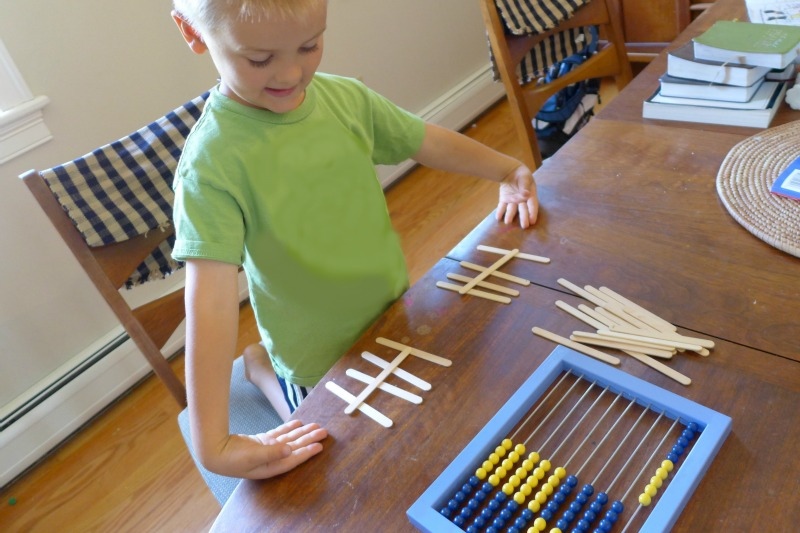
- Use the Cotter Abacus. Encourage your child to recognize quantities by their visual arrangement rather than moving beads one at a time.
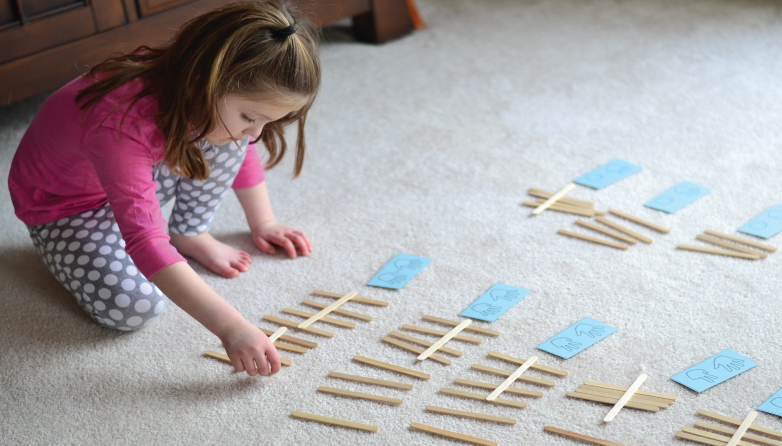
- Play math games. Games provide natural repetition without turning practice into tedious drill. RightStart Math incorporates games specifically to provide meaningful practice and application.
Most importantly, make it fun and low-pressure.
Extending Subitizing Beyond 10
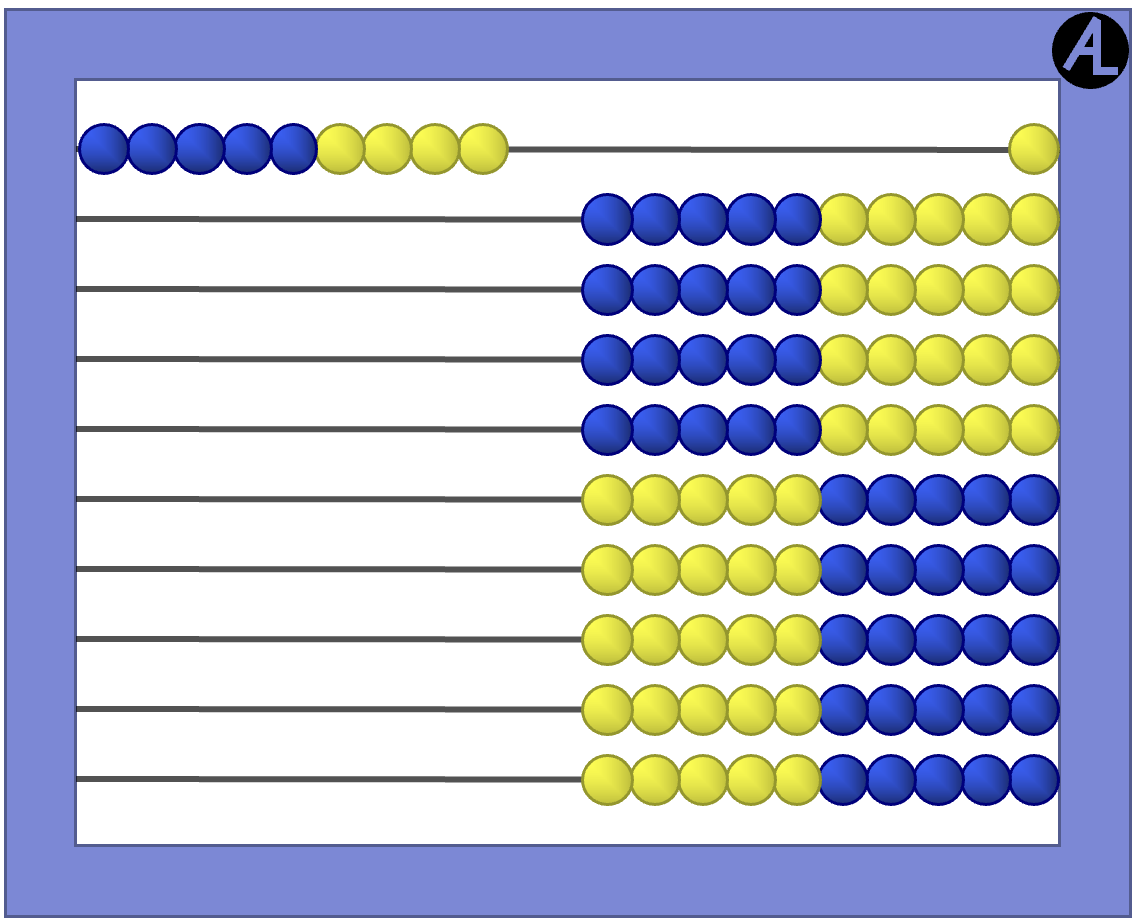
Subitizing can be extended beyond 10 when the grouping by 5s and 10s is extended.
Look at this quantity:

Because there are 10 in the two rows and 4 more, the quantity of 24 does not need to be counted. It is subitized!
Compare the subitizable group above to this ungrouped quantity of apples:

Which is easier? Which can you image this quantity in your mind and be certain it is correct?
Here is another quantity:

The five 10s is quickly subitized, then one more 10 identified by the color change grouping and 7 more; the quantity of 67 can be seen without counting.
Start Seeing Math Differently
For many homeschool families, learning about subitizing is a lightbulb moment. We often assume that knowing numbers means being able to count them. But mathematics is much more than counting.
A child who can see quantities, recognize groups, visualize numbers, and understand relationships is developing the kind of number sense that can support increasingly sophisticated mathematics.
That’s why subitizing matters.
It may look like a child simply glancing at five beads and saying, “Five.” But underneath that quick response is something much bigger: the beginning of seeing mathematics as quantities and relationships rather than a series of items to count.
And that is exactly the kind of mathematical thinking we want to nurture in our homes.
See it. Understand it. Visualize it. And then use it.
That is the power of subitizing.
Sources and Further Reading
RightStart Mathematics incorporates subitizing throughout its approach to number sense, visualization, grouping, and mathematical strategies. Curriculum developer Joan A. Cotter discusses children’s ability to subitize and benefits of this important skill.
For research-based background, see the research of Clements, Sarama, and MacDonald on subitizing and early number development.