

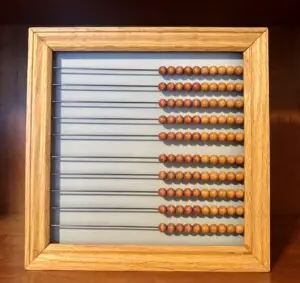
I know it’s hard to see, but the beads are light wood and darker wood, although they have faded over time. See how the colors don’t switch after five? But that there’s a gap, so the groups of fives can be recognized? And there is not a Side 2 with this first design.
Once Dr. Cotter developed Side 2, here’s how it was marked. It was a sticker!
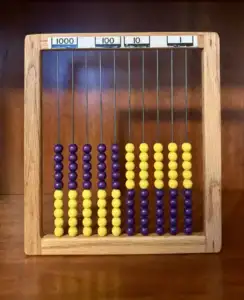
Here’s a Cotter Abacus with translucent beads, perfect for an overhead projector. Remember those?
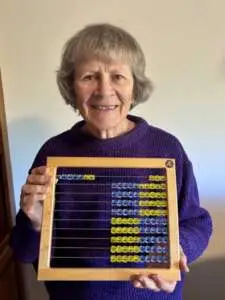
But what about all the other abacuses – the ones that are from around the world?
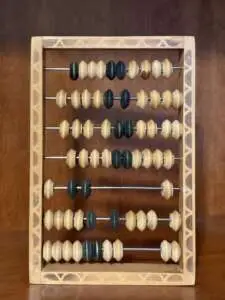
She has a Russian abacus. If you’re curious how it works, check out the Start Math Right book where she tells you how to use it on pages 60–62.
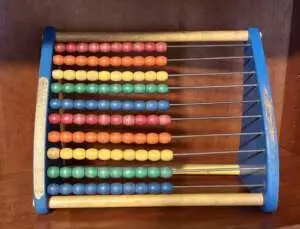
And here’s a vintage Playskool abacus. Notice the tape with “1000” on the left side? Dr. Cotter put that there to teach place value to her kids. She said, “It didn’t work.”
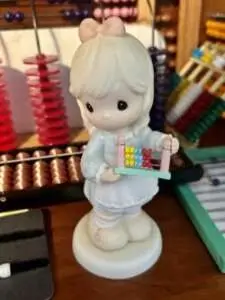
Here’s another cute “abacus.” Interestingly enough, the beads do move!
Finally, here is the best abacus, in my opinion. This is an Alaskan Yup’ik abacus.
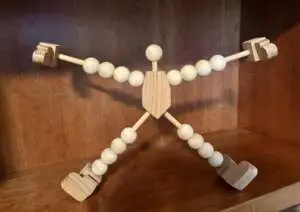
The beads on the arms and legs each represent one. There is a hinge on each hand and foot; if the hand or foot are extended (this picture has the hands and feet in), then that indicates 5. So, given the way this abacus is standing, it represents 8; four on each leg for a total of 8.
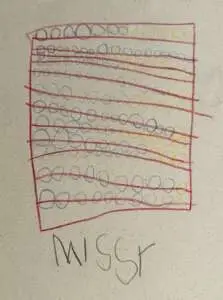
Finally, here’s a drawing made by a first-grader. Missy was one of the children in the research group. This is her “thank you” note to Dr. Cotter, although she did take artistic liberties with the abacus design.
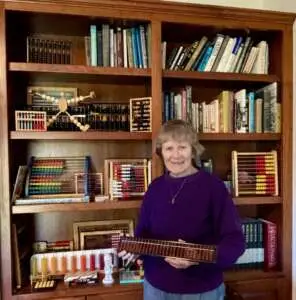
So, how many abacuses does Dr. Cotter have on her display? 41!!
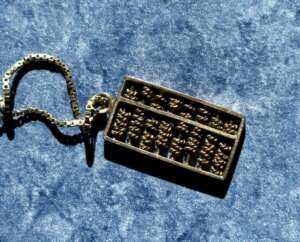
Well, actually, that’s not true. Go back and look at the first picture of Dr. Cotter. See her necklace? Here’s a close up. It’s a Chinese abacus! So….
4 Comments
Salomey
Great ! Is there a way we can use the Japanese Abacus with the rightstartmaths program? Checking from the program it’s the cotter abacus but here in Ghana we use the Japanese Abacus
Kathleen Cotter Clayton
Great question! Although there are a lot of similarities with the Cotter Abacus and the Japanese abacus, there is one core difference. The Cotter Abacus provides an environment for the user to learn and to build visual strategies. The Japanese abacus relies on mental math and is more like a calculator. In other words, the Cotter abacus lays the foundation for the work needed with the Japanese abacus.
Side 2 of the Cotter Abacus is more like the Japanese abacus. But, again, the Cotter Abacus bead layout builds understanding (when trading 10 ten beads for 1 hundred for example), whereas the Japanese abacus begins with the knowledge that 10 tens is 1 hundred and simply uses it to calculate.
In short, the Cotter Abacus is a teaching tool for building understanding. The Japanese abacus is a calculation tool for performing operations efficiently.
Roberta Bond
The second picture is the one with which I’m familiar. Our family still has all three of our original abacuses. Each one has slightly different colours. Blue and yellow, pink and purple and purple and yellow. These were for my first three children. They were passed on to the next two. Then the last two. And now, my 2 year old granddaughter enjoys playing with them. My infant grandson will be next….
I’ve had our original abacus for 30 years. I call that a VERY good investment!
Kathleen Cotter Clayton
Love this!!!!
Comments are closed.