
I recently got a call from Amanda and her son Zach. They had a question about RightStart Math Level F, Lesson 116 and 117. The topic of the day was combinations, which is another word for possibilities. This is a good topic to explore, as it is the beginning work for probability and statistics.
Here’s one of the first basic problems: Sidney is taking four shirts and three pairs of shorts to summer camp. How many different outfits will they have to wear?
One way to look at it is each shirt can be work with three pairs of shorts, so 4 shirts x 3 shorts is 12 different outfits. Or, each pair of shorts can be worn with four shirts; 3 shorts x 4 shirts is the same 12 different combinations.
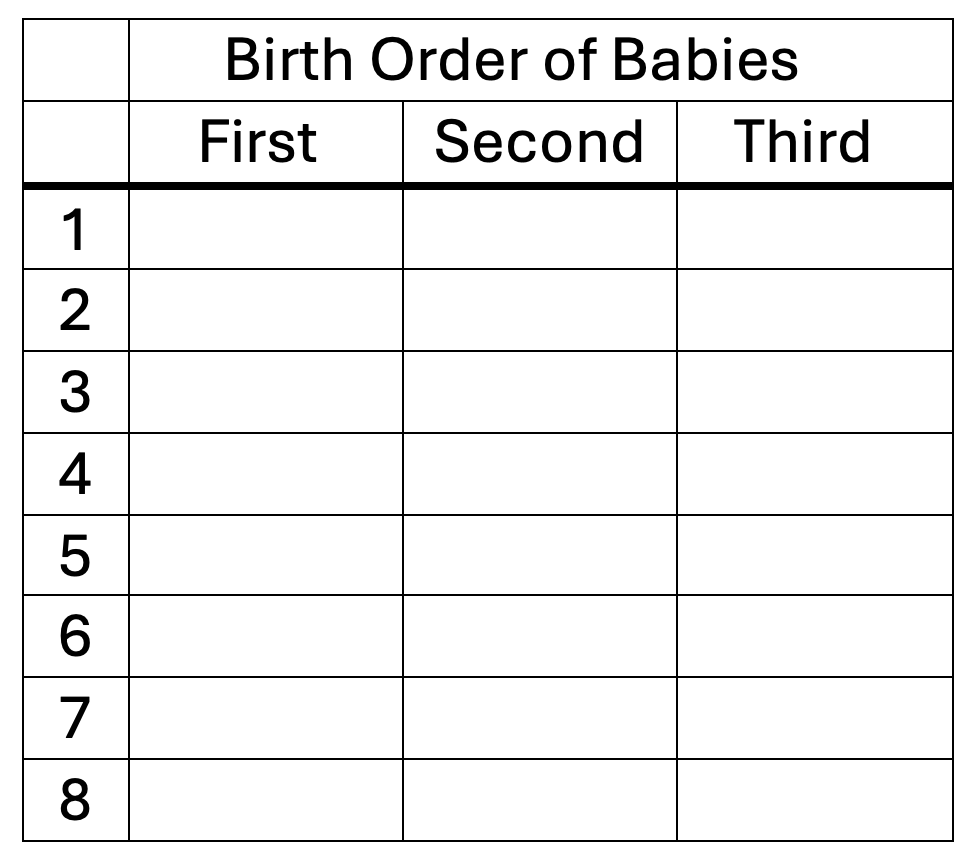
But what happens when we get more variables? Look at this problem: The Kaplan family is going to have fraternal triplets, which means they will not be identical. Using the table below, list all the possibilities on whether the babies will be girls or boys.
Zach had a pretty good handle on the situation, but Amanda and I struggled a bit more. After a few false starts, we started to approach it systematically.
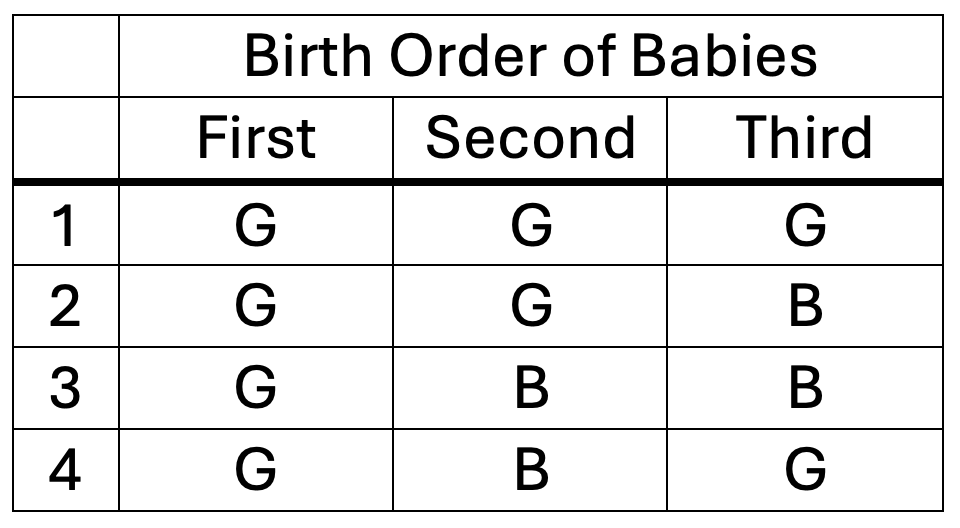
- All the babies might be girls.
- The first two babies are girls and the third baby is a boy.
- Maybe the first baby is a girl and the next two babies are boys.
- Or, maybe the first and third babies are girls and the second baby is a boy.
This is working well! Now let’s thinking this through with the boys as the “lead.”
- All the babies could be boys.
- The first two babies are boys and the third baby is a girl.
- The first baby is a boy and the next two babies are girls.
- Finally, the first and third babies are boys and the middle baby is a girl.
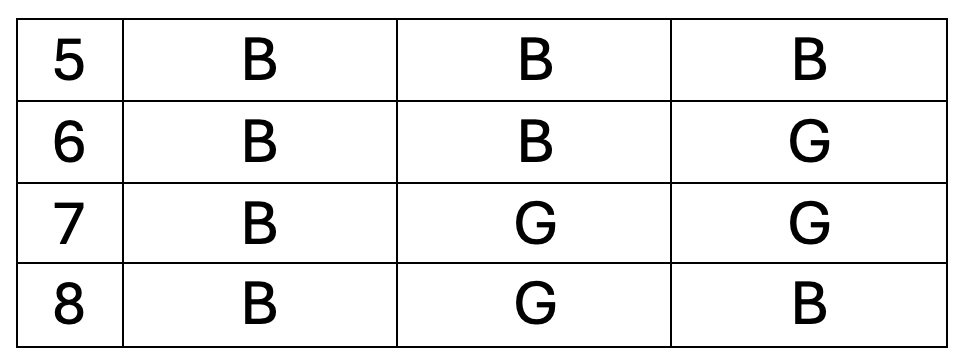
Here’s the completed chart:
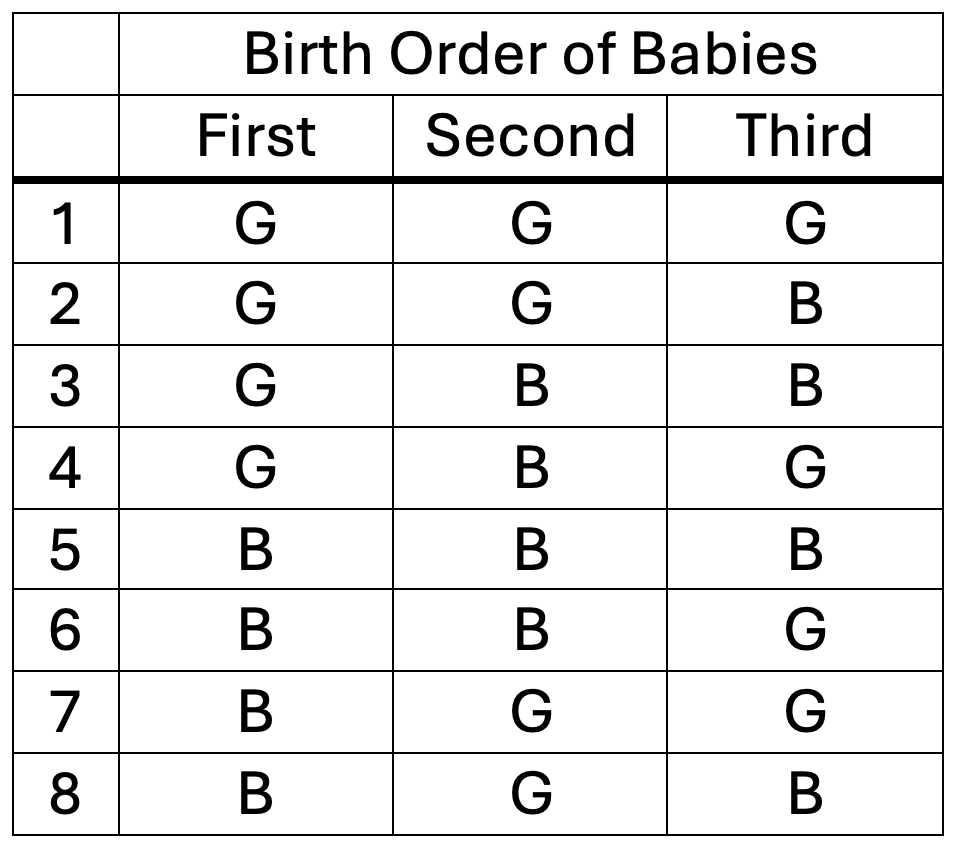
Now, let’s extend this situation and ask some questions about the probabilities.
- What is the probability the babies will be either all boys or all girls?
We have 2 out of 8 possibilities that the babies are all boys or all girls, which can be written as 2/8 or 1/4.
- What is the probability at least one baby is a boy?
Since there is only one scenario where there are no boys, the probability is 7 out of 8, or 7/8 chance of at least one baby being a boy.
- What is the probability only one baby is a girl?
At first, we quickly answered 7/8, thinking it was the same probability as the previous question. But then we realized the question reads “only one.” Well, that’s a different story! There are three possibilities of the babies being only one girl, so we have 3/8 probability.
- What is the probability only two babies are girls?
I will confess we were a little more cautious with this question, having burned ourselves in the previous question. OK – only two girls…. That will be 3 out of 8 or 3/8.
After we got the answers, Zach had a good question. He said, “Why does this matter? I’ll never need this information.” And I couldn’t argue with him!
But it’s not about calculating the possible gender of triplets. Rather, it’s practicing logical and organized thinking. Which, interestingly enough, Zach did a better job at that his mother and I did!
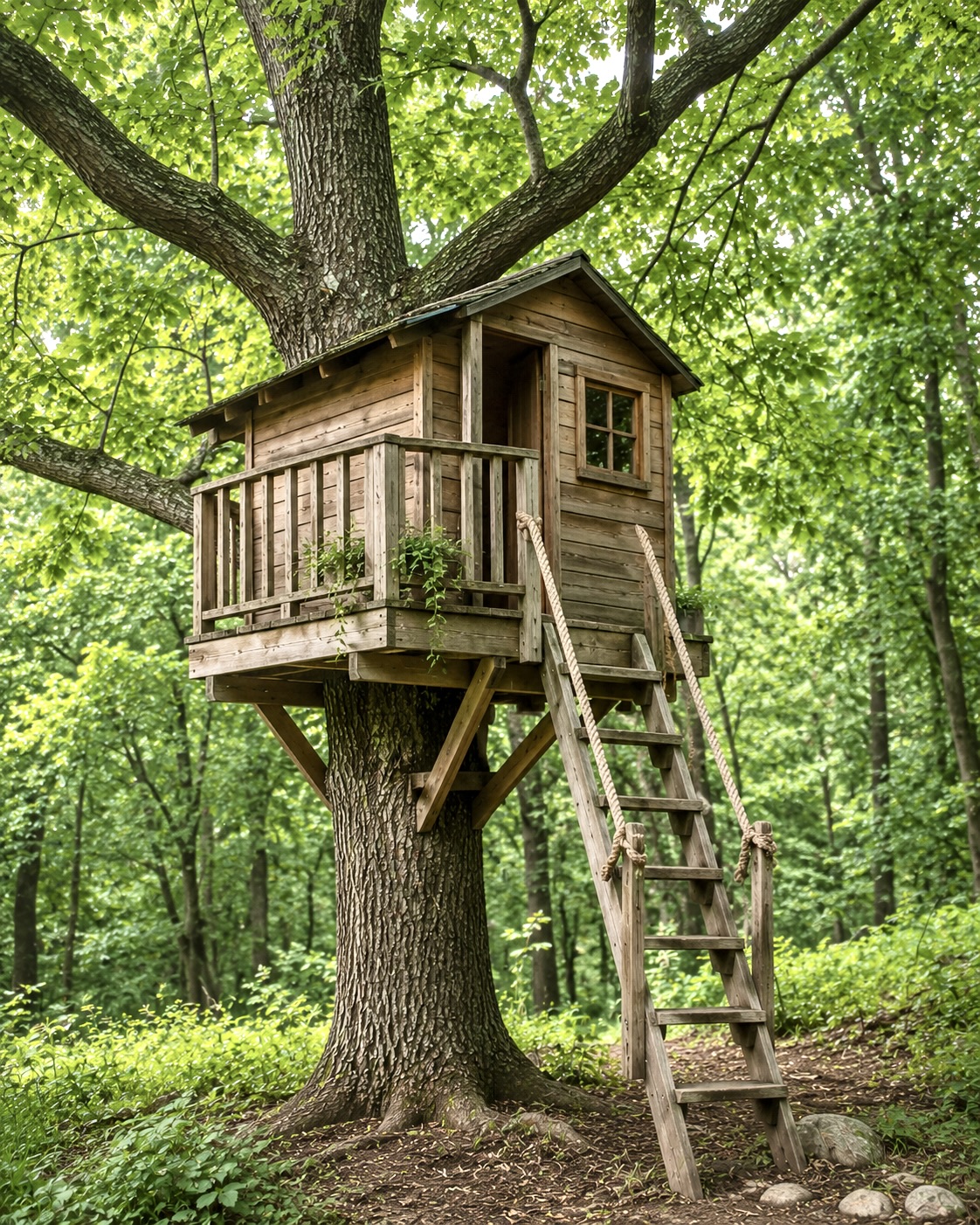
Logical and organized thinking is very beneficial in life, both as a kid and as an adult. I asked Zach how building a treehouse willy nilly might work. It could be a colossal disaster. But if the building was approached in an organized fashion, laying the floor first, then attaching the walls and building the roof, the progress will be solid and sure.
That is why we work through these types of problems; it helps us become logical and organized thinkers, and when faced with a situation we haven’t seen before, we excel because we’ve been training for it!