
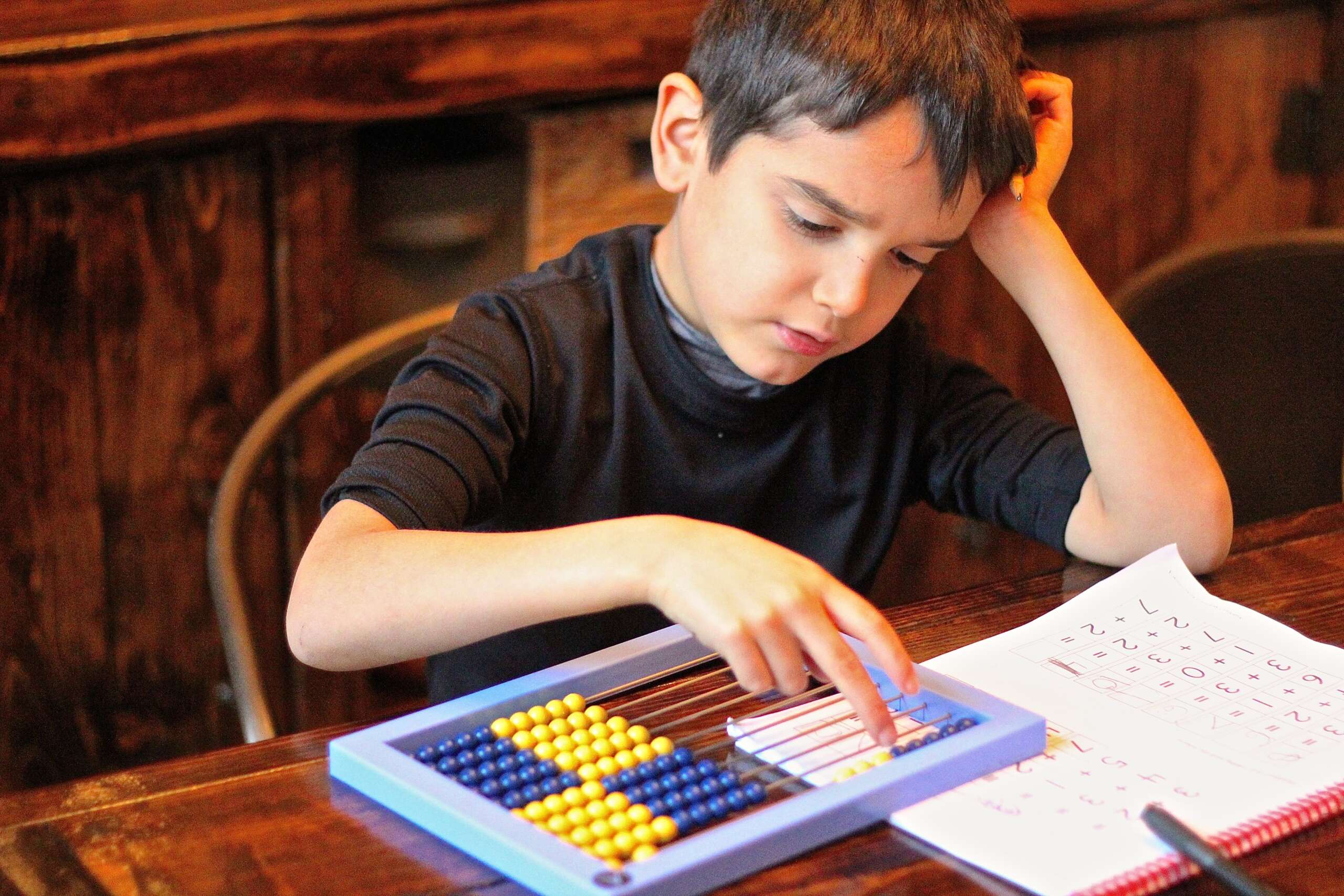
What if your child could look at a number and actually SEE it?
Not just recognize the symbol 8, but understand that 8 is five and three, two groups of four, one more than 7, two less than 10, or 4 doubled?
That is number sense.
Number sense is more than knowing how to memorize rigid rules and procedures and reciting math facts. It is an intuitive, flexible understanding of numbers, quantities, relationships, and how numbers work together. It helps children understand how numbers relate to one another, break numbers apart and put them back together, recognize patterns, estimate, calculate mentally, and determine whether an answer makes sense.
In other words, number sense is what allows children to think mathematically.
Without Number Sense, Math Becomes Sheer Memorization
When children don’t understand numbers, they have very few tools for figuring things out. They are left trying to remember isolated facts and procedures.
What is 7 + 6?
If a child has been taught only to memorize, the answer is simply a 1 and a 3, also known as 13. If they forget it, they may have no idea how to recover the answer.
And what is 7 – 6? Just because we lost the vertical part of the plus sign, turning it into a minus sign, the answer is now just 1. And how about 7 × 6? We turned the plus sign 45º, now the answer is a 4 and a 2, also known as 42. That just feels crazy!
Back to 7 + 6, a child with number sense can think:
7 + 6 = (5 + 2) + (5 + 1) = 10 + 3 = 13
The child understands the quantities and the relationship between them. They can derive the answer rather than desperately search their memory for it.
This is one of the fundamental differences between memorizing math and knowing math.
At RightStart Math, we believe children should develop understanding first and allow fluency to grow from that understanding. Rather than asking children to memorize a long list of isolated facts, RightStart uses grouping, strategies, and visualization to help children understand how numbers work together.
As Dr. Joan A. Cotter’s approach emphasizes, children can learn to visualize quantities and mathematical strategies so that, eventually, they can think about them mentally.
Without number sense, a child may know the answer. Or not. But with number sense, a child knows why the answer makes sense.
F + E Problem
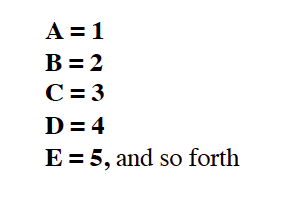
To experience adding without number sense, let’s use the alphabet instead of numbers; A is 1, B is 2, C is 3, and so on.
Now add F + E.
First count out F counters (A, B, C, D, E, F). Next count out E counters (A, B, C, D, E).
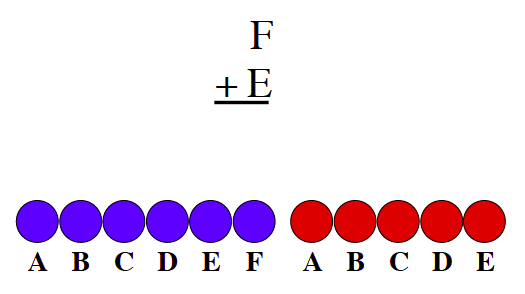
How much is it altogether? Other than counting, there’s no way to get the answer.
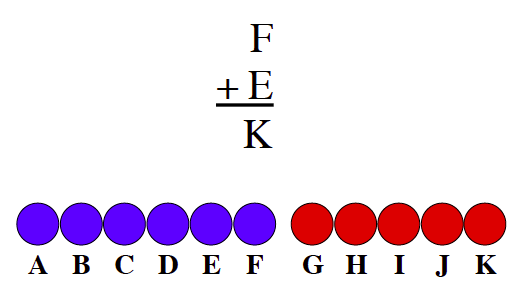
Without counters, how would you count from F? You might use your fingers: raise one finger for A, while saying G. Then raise another finger for B, while saying H. Continue until you raise E fingers and say K.
Without fingers, a tedious mental dialogue takes place: A is G, B is H, C is I, D is J, and E is K. What a lot of work!
Then comes the next step: “Memorize the facts!”
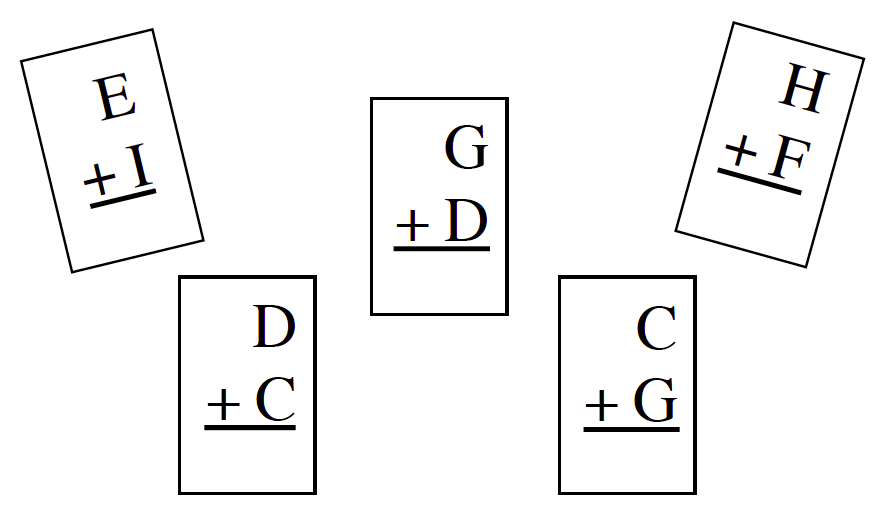
Flash cards don’t work for one out of five children — especially those with learning challenges.
The problem isn’t that children are incapable of memorizing. The problem is that memorization without understanding gives children little to fall back on when they forget.
This is especially important for children who struggle with traditional approaches to math.
Without Number Sense, Seeing Patterns Is Nearly Impossible
Mathematics is filled with patterns.
- Ten ones make one ten.
- Ten tens make one hundred.
- Five plus five makes ten.
- Six plus four makes ten.
- 7 × 5 is the same as 5 × 7.
- 25 is one-fourth of 100.
- 0.5 is the same as 5/10s.
These relationships are everywhere.
But children cannot easily see mathematical patterns if they experience numbers as isolated symbols that must each be memorized. As mathematics becomes more advanced, recognizing relationships becomes essential for understanding fractions, decimals, multiplication, division, percentages, and algebra.
Number sense turns individual facts into connected ideas.
Number Sense Builds the Foundation for Future Math
Number sense isn’t just an early elementary skill. It is the foundation upon which later mathematics is built.
Children who understand numbers are better prepared for:
- addition and subtraction
- multiplication and division
- place value
- fractions
- decimals
- percentages
- measurement
- estimation
- algebra
- problem solving
Consider 48. It isn’t simply a symbol to memorize. It is 4 tens and 8 ones. It is also 50 − 2. It’s 24 doubled or 12 times 4. The more relationships children see, the more flexible their mathematical thinking becomes.
Number Sense Helps Children Solve Problems
Math isn’t just about answering equations on a worksheet.
Real mathematics requires children to decide what to do, select a strategy, and determine whether their answer makes sense.
Imagine a child solving a word problem and getting an answer of 742 when the problem was about the number of cookies in three small bags.
A child with number sense can stop and think, That doesn’t seem reasonable.
That ability to estimate and judge reasonableness is an important part of mathematical thinking.
And number sense matters beyond school, too. We use it throughout our lives.
We estimate how much groceries will cost. We calculate tips. We determine whether we have enough money to make a purchase. We compare prices. We figure out how much time we have before we need to leave. We estimate distances and quantities. These everyday tasks require an understanding of numbers and their relationships.
Does Your Child Need to Work on Their Number Sense?
If your child needs to build or strengthen their number sense, we have a simple way to help. RightStart Tutoring: Number Sense includes 50 lessons filled with games and activities—without a single worksheet.
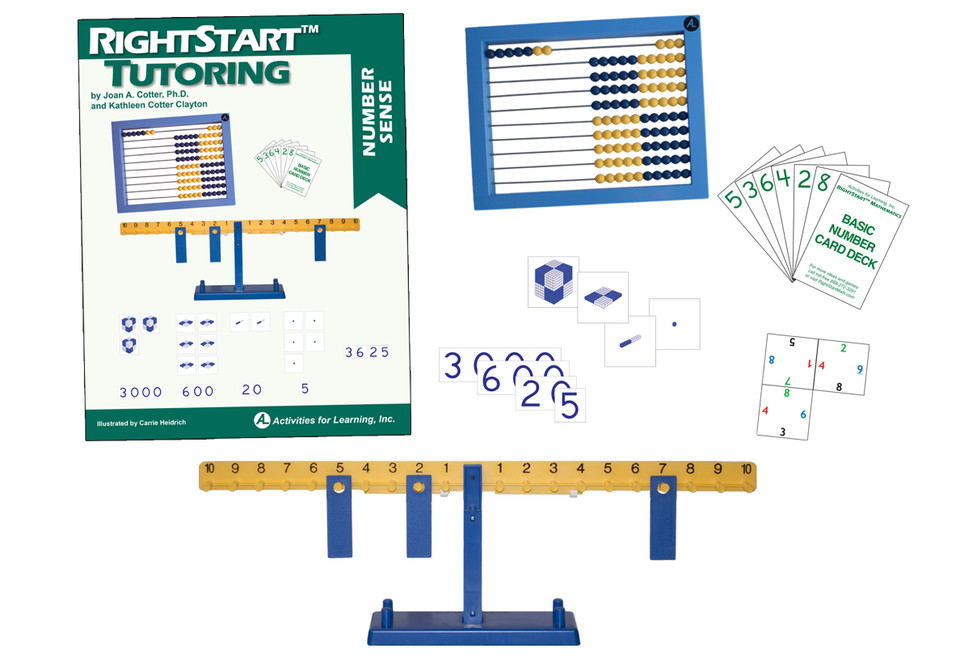
The lessons begin with recognizing quantities, also known as subitizing, and gradually build a deeper understanding of numbers. Children work through simple addition and subtraction and eventually progress to four-digit addition and subtraction.
And you don’t have to change your entire math curriculum to use it. RightStart Tutoring: Number Sense can be used alongside whatever math program your child is currently using. It is designed for children ages 8 to 18 who need to strengthen their foundation and develop a better understanding of numbers. Go here to peek into the table of contents and see sample lessons.
For younger children, we recommend starting with the RightStart Math program. If your child is just beginning their math journey, start with Level A. If they have completed a kindergarten program and are starting to work on addition, Level B is a good place to begin.
The Goal Is Understanding, Not Just Answers
Without number sense, mathematics can become an overwhelmingly long list of facts, rules, and procedures to remember.
With number sense, mathematics becomes a connected system of ideas.
- Children can see patterns.
- They can break numbers apart.
- They can put numbers together.
- They can choose efficient strategies.
- They can estimate.
- They can check their answers.
- They can solve unfamiliar problems.
- And they can begin to trust their own mathematical thinking.
That is why number sense matters.
We don’t want children simply to know that 7 + 6 = 13. We want them to understand WHY it is 13—and to have several ways to figure it out if they forget.
Because when children understand numbers, they aren’t merely memorizing mathematics.
They’re learning to think mathematically.