
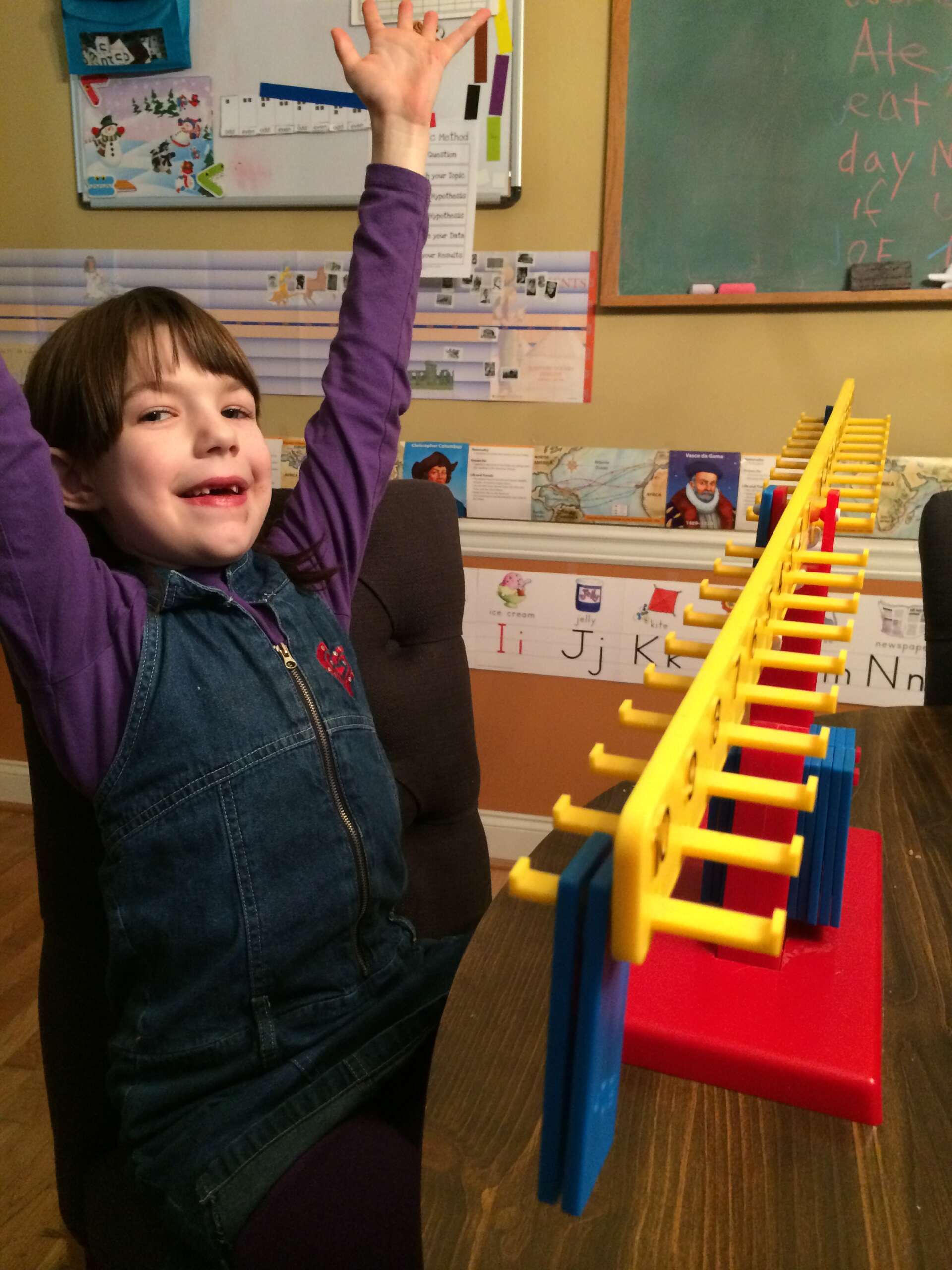
Confidence is a powerful thing.
Think about a child who is willing to attempt an answer—even when they aren’t completely sure. Think about the child who sees a challenging problem and thinks, I can figure this out, rather than immediately thinking, I’m just not good at math.
That difference matters.
Confidence acts like a superpower for children.
Confidence gives them the courage to try new things, the persistence to work through challenges, and the willingness to learn from mistakes. And when children experience success after working through something difficult, their confidence grows even more.
This is especially important in mathematics.
Confidence Helps Children Keep Going
Every child encounters something difficult in math. Maybe it is a new concept, a challenging word problem, or a calculation that doesn’t immediately make sense. If a child believes that being “good at math” means always knowing the answer quickly, a mistake can feel like failure.
But what if a child understands that mistakes are simply part of learning?
That child is much more likely to keep trying.
Confidence helps children develop a growth mindset—the belief that their abilities can grow through effort, understanding, practice, and persistence. Instead of thinking, “I can’t do this,” they begin to think, “I can’t do this yet.”
That small change in thinking can make a tremendous difference.
RightStart Math intentionally creates opportunities for children to think, explore, make connections, and develop strategies. The goal isn’t simply to produce children who can quickly recall answers. It is to help them become mathematical thinkers who can reason through problems and trust their own thinking.
Confidence Shapes a Child’s Academic Identity
Something else happens as children experience success in mathematics: confidence shapes their academic identity.
A child who repeatedly struggles with math may eventually begin to describe themselves as “not a math person.” Once that belief takes hold, it can influence how they approach future learning. A difficult problem isn’t simply difficult—it becomes evidence that they aren’t capable.
The opposite will also happen.
When children experience mathematics as something they can understand, they begin to see themselves as capable learners. They become more willing to participate, ask questions, try strategies, and tackle unfamiliar problems.
That identity can follow them far beyond elementary mathematics.
A confident math student is more likely to approach algebra, geometry, science, technology, and everyday situations with the belief that they can figure things out.
And that is a much more valuable outcome than simply getting the right answer on today’s worksheet.
The Purpose of Math Is More Than Knowing the Facts
This is one of the reasons RightStart Math places such a strong emphasis on understanding.
The purpose of mathematics is not simply to know a collection of facts.
Yes, children need to become fluent with mathematics. But knowing that 7 × 8 = 56 is only one small piece of mathematical understanding. What happens when a child encounters a problem they have never seen before?
Can they use what they know?
Can they recognize relationships?
Can they break a problem into parts?
Can they choose a strategy?
Can they determine whether their answer makes sense?
The purpose of mathematics is to apply it to new situations.
RightStart Math emphasizes visualization, number sense, strategies, and understanding so children have tools they can use when they encounter something unfamiliar. Instead of relying solely on memorized facts, they learn to see quantities, recognize patterns, make connections, and reason their way toward solutions.
That’s where real confidence comes from.
Understanding Math Builds Confidence
Imagine two children are asked to solve a problem.
One child knows a procedure but isn’t sure why it works. If the problem looks different from the examples they’ve practiced, they may become stuck.
The other child understands the mathematical relationships involved. Even if the problem is unfamiliar, they have strategies to try. They can reason, make an estimate, visualize the quantities, and check their answer.
Which child is more likely to feel confident?
The second child.
Understanding math builds confidence.
When children understand why mathematics works, they have something to fall back on when they forget a fact or encounter a new problem. RightStart describes this distinction clearly: children who understand mathematics can derive answers, choose efficient strategies, check their work, and solve unfamiliar problems.
In other words, understanding gives children a safety net.
They don’t have to know everything immediately because they know how to think.
Mathematics Is Meant to Be Used
Ultimately, mathematics is not just a school subject. It is a tool for understanding and improving the world around us.
We use mathematics to design buildings, develop medicines, analyze information, create technology, manage businesses, understand science, build bridges, explore space, and solve problems that haven’t even been imagined yet.
Even closer to home and more immediate, mathematics is used with:
- time — figuring out when to leave for an appointment, allowing time to get ready and travel, and determining how much time is left before you have to leave
- sports — keeping score, calculating averages, measuring distances, tracking time, and comparing statistics
- weather — reading temperatures, comparing changes, understanding percentages of rain, determining and how much snow or rainfall occurred, and
- using technology — understanding storage capacity, battery percentages, download times, and data usage.
The purpose of learning mathematics is to prepare children to use it.
We want our children to be able to apply mathematical ideas to situations they have never encountered before. We want them to look at a problem and see possibilities, not limitations.
And we want them to understand that mathematics can help make our world a more beautiful, healthier, stronger, and happier place to live.
That begins with children who believe they can think mathematically.
Give Children More Than Answers
When we focus only on correct answers, we can unintentionally send children the message that mathematics is about being fast, remembering everything, and never making mistakes.
But mathematics is so much more.
Math is thinking.
Math is exploring.
Math is discovering patterns.
Math is solving puzzles.
Math is making connections.
And sometimes, math is making a mistake, figuring out what went wrong, and trying again.
That is why confidence matters so much.
We don’t want children to leave their math lessons simply knowing more facts. We want them to leave believing, “I can figure this out.”
Because that belief changes everything.
Understanding math builds confidence. And confident children are willing to try, persist, make mistakes, learn, and tackle problems they have never seen before.
RightStart Math provides the kind of mathematical learning that prepares children not only for their next math lesson, but for a lifetime of thinking, solving, creating, and contributing.
And that is the real purpose of mathematics.
- Filed Under: General Info
- Tagged With: Building Math Confidence, Confidence in Math, Confident Math Learners, Growth Mindset in Math, homeschool math, math anxiety, math confidence, Math Education, Math Strategies, math success, Mathematical Thinking, number sense, RightStart Math, teaching math, understanding math