
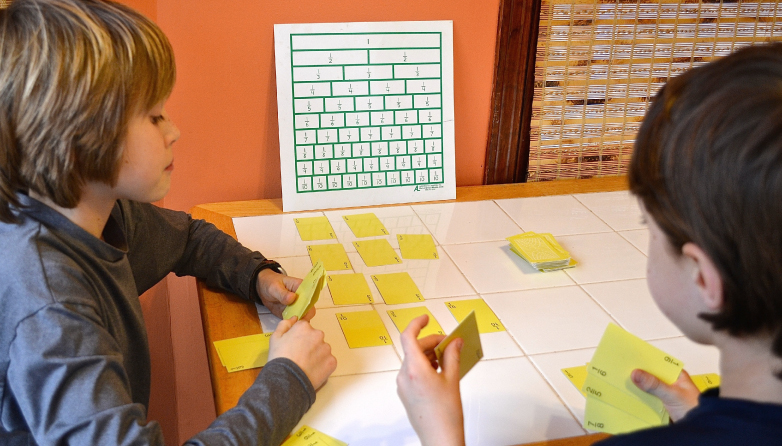
What if practicing math facts didn’t feel like practice?
What if children could learn, review, and strengthen their math skills while laughing, talking, thinking, and playing with someone they love?
That is the idea behind math games in RightStart™ Mathematics.
Games are to math as books are to reading.
When a child learns to read, we don’t expect them to spend all their time practicing individual letters and words. Once they have learned the skills of reading, we give them books. Reading gives children a reason to use what they have learned. They encounter words again and again, but the repetition has a purpose: they are reading a story, learning something interesting, or simply enjoying a good book.
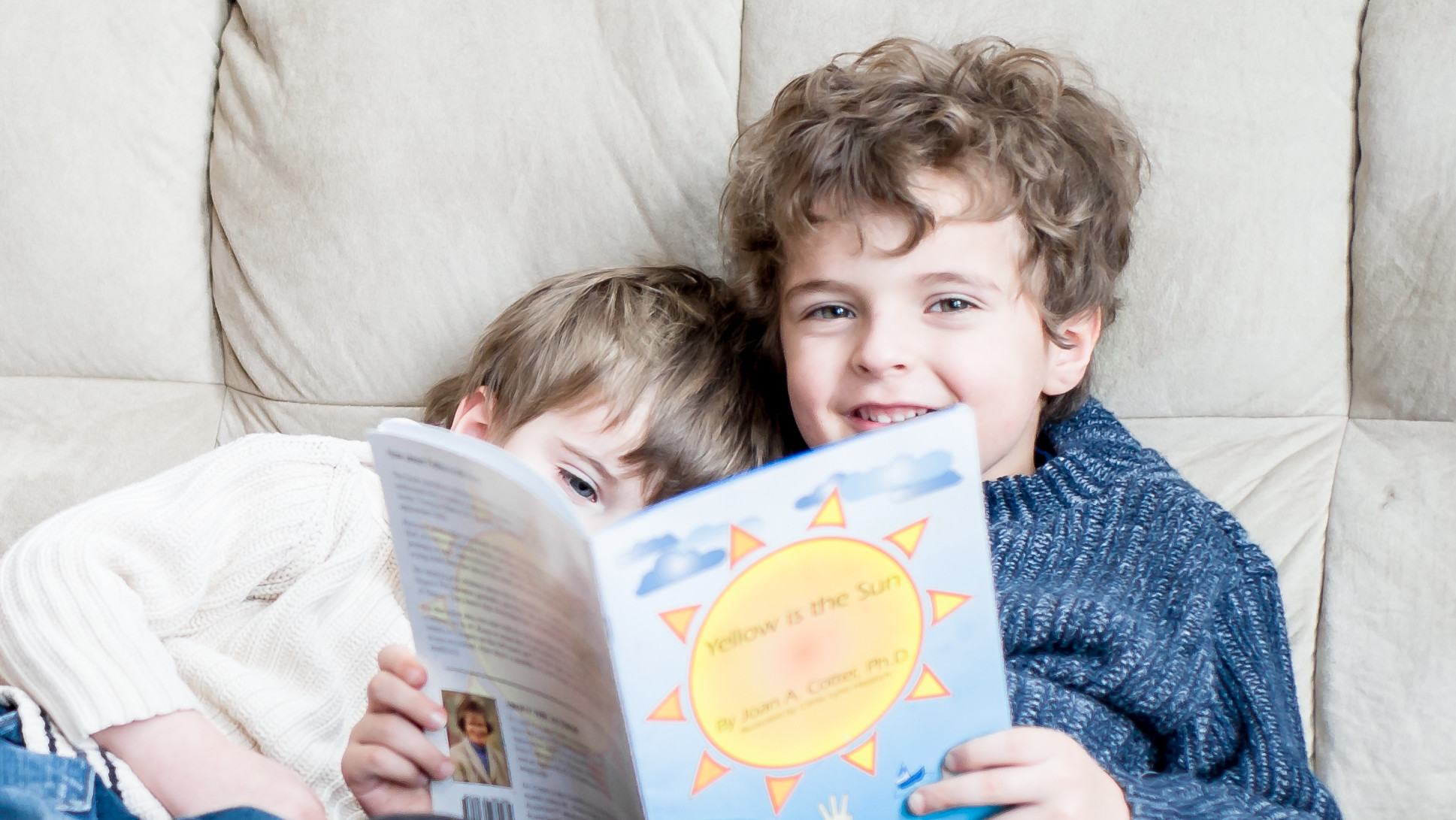
Math needs that same kind of application.
Once children have learned a new mathematical idea or strategy, they need opportunities to use it. RightStart Math uses games to provide those opportunities. Rather than endless worksheets or stressful flash cards, children use their new knowledge while playing a game. The game gives them a reason to know their facts.
Games Make Practice Enjoyable
Children need repetition to become fluent with mathematics. But repetition does not have to mean doing the same type of problem over and over and over on a worksheet.
Games provide interesting repetition.
A child may encounter the same addition, multiplication, or fraction concept many times, but each game presents it in a different situation. Different cards appear. Different numbers are combined. Different decisions have to be made. The child is repeatedly thinking about the mathematics without experiencing it as repetitive drill.
RightStart Math emphasizes that games provide the interesting repetition children need to develop automatic responses, while also providing an application for newly learned information.
And there is another important difference: joy matters.
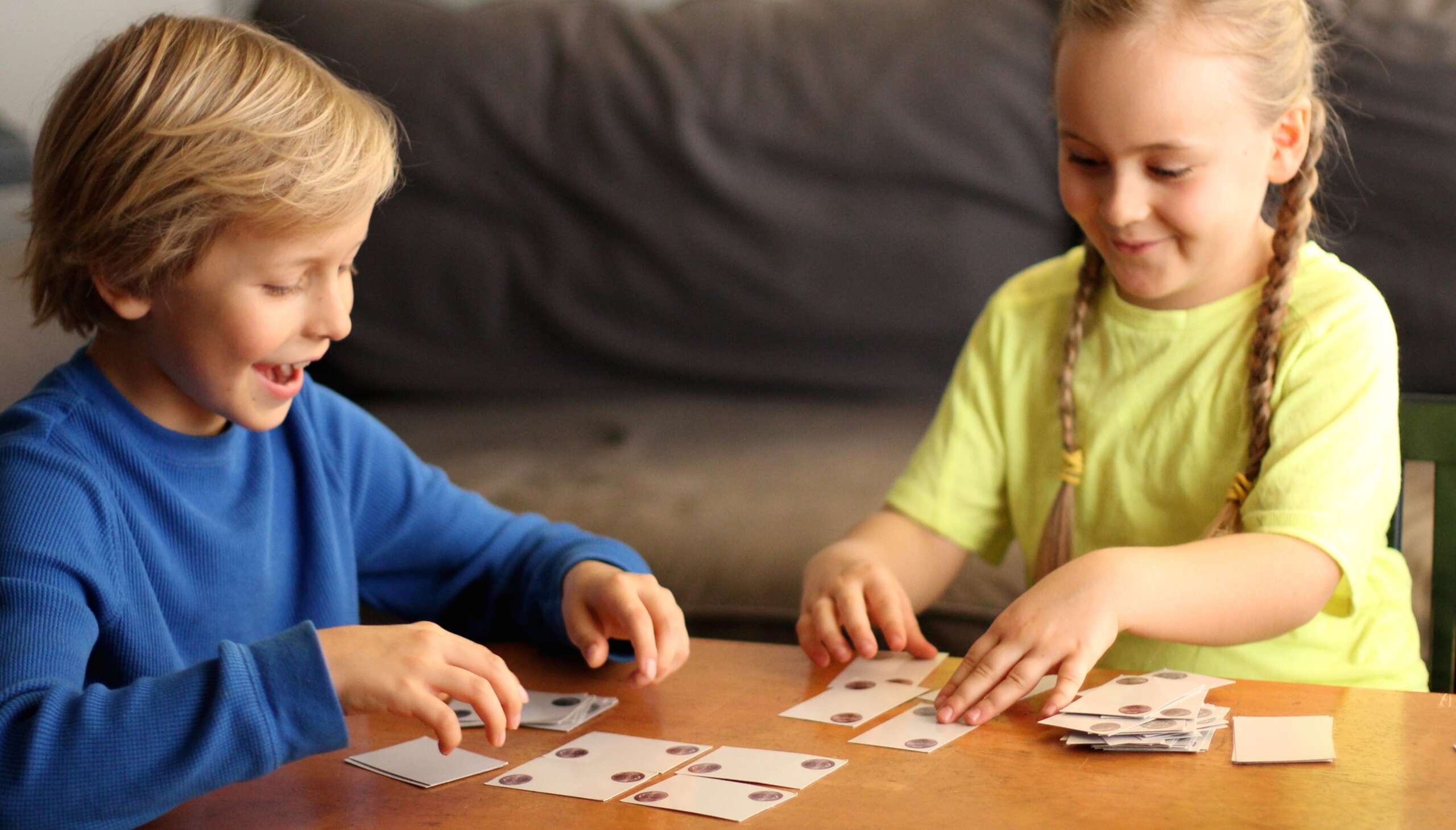
Research on game-based mathematics learning suggests that games can help reduce math anxiety, particularly when the games involve social interaction and collaboration. A meta-analysis of game-based mathematics learning found an overall reduction in math anxiety, with stronger effects associated with social and collaborative games.
That makes sense. A child sitting across the table from a parent or sibling, concentrating on a game and enjoying the experience, is having a very different emotional experience from a child staring at a page of problems while worrying about getting the answers wrong.
Games can help create a positive emotional experience around mathematics. Children can talk, laugh, make decisions, and try again. The focus shifts from “Am I going to get this problem right?” to “What should I do next?”
Games Don’t Just Practice Math—They Teach It
This is one of the most important things to understand about RightStart Math games.
The games aren’t simply a reward after the real math lesson. The games are part of the teaching.
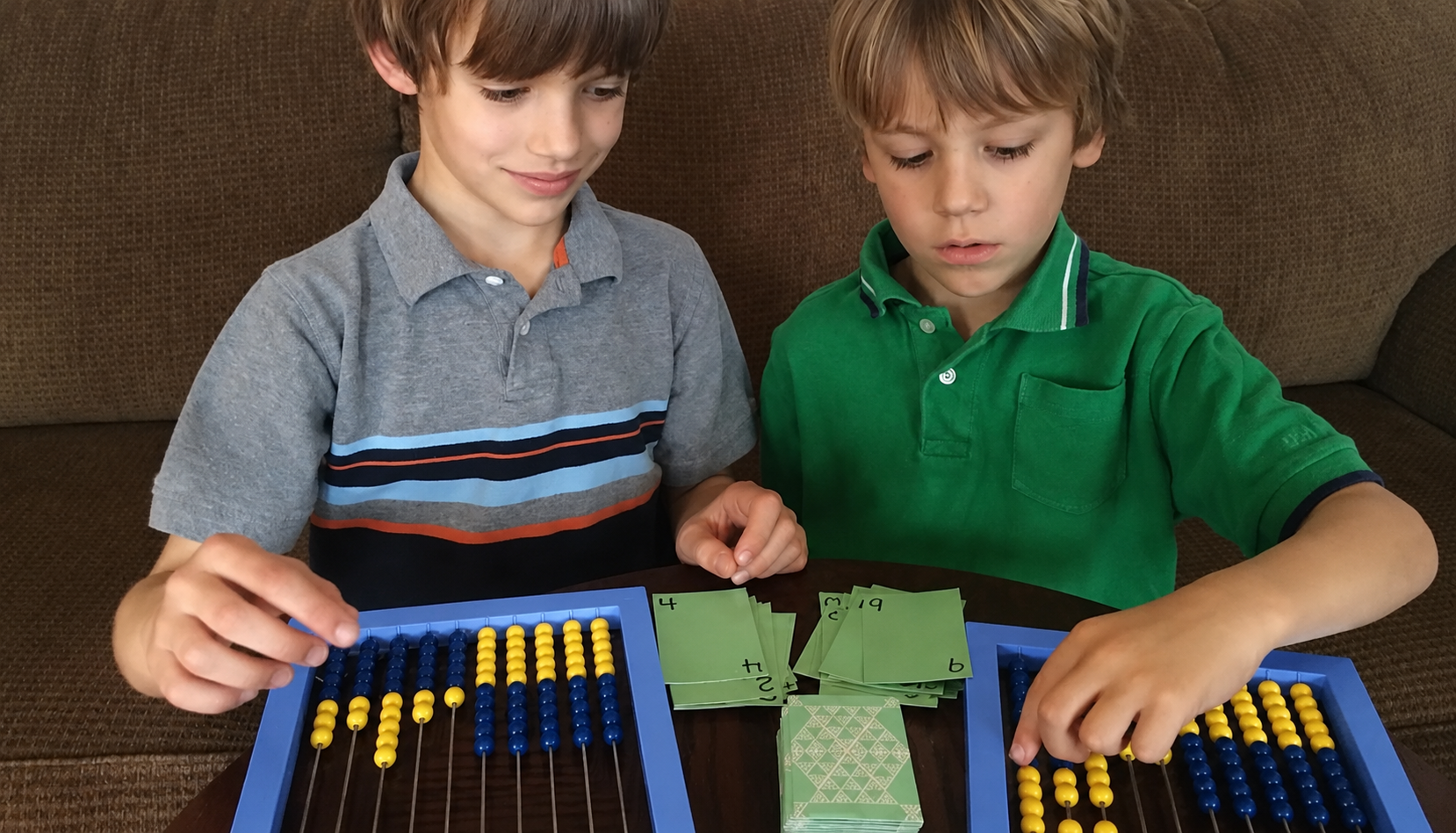
Children do not necessarily need to know all their facts before they begin playing. RightStart’s games are designed so that children can develop mathematical skills while they play. They learn and practice facts as they play, using the Cotter Abacus or fraction chart when needed for support.
That is a significant distinction.
A traditional approach might look like this:
Teach the concept → memorize the facts → drill the facts.
RightStart Math takes a different approach:
Teach the concept and strategy → play the game → think mathematically → practice in real life → develop understanding and fluency.
The Math Card Games book contains more than 300 games covering number sense, addition, subtraction, multiplication, division, fractions, money, and clocks. Within each chapter, the games progress from easier to more advanced. Different games can also address the same objective, giving children variety while they continue developing a skill or concept.
The goal isn’t simply to produce a child who can recite an answer. The goal is to develop a child who understands the mathematics and can think their way to an answer.
But How Do I Learn the Games?
This is a question many parents have when they first open Math Card Games and discover more than 300 games!
Don’t worry—you don’t have to figure them all out by yourself.
The Math Card Games book provides written instructions for the games. RightStart Math recommends actually handling the cards and materials as you read the instructions. Seeing the cards in front of you can make the directions much easier to understand.
RightStart Math also provides instructional videos for many of the games. The videos demonstrate how the games are played, and they are organized by level and topic. Watching someone play a game can make the rules much clearer than simply reading them.
There are also additional game instructions and blog posts on the RightStart Math website. Many include pictures, explanations, and ideas for using the games. You can search the RightStart Math website by the game name or game number to see if additional help is available.
And if you are trying a game and still aren’t quite sure how it works, don’t hesitate to search for the game online. You may find additional explanations or demonstrations. You can even ask an AI tool to explain the basic rules of a particular game.
The goal isn’t to become an expert at all 300-plus games.
Pick a game. Learn how to play it. Sit down with your child. And play.
You’ll discover that some games become family favorites, while others may not be a good fit for your child right now. That’s okay. The Math Card Games book is designed to give you plenty of choices.
Older Children Can Teach While They Play
One of the wonderful things about math games is that they can bring children of different ages together.
An older child can play a game with a younger sibling. At first, it may seem as though the older child is simply helping the younger one. But something important is happening for both children.
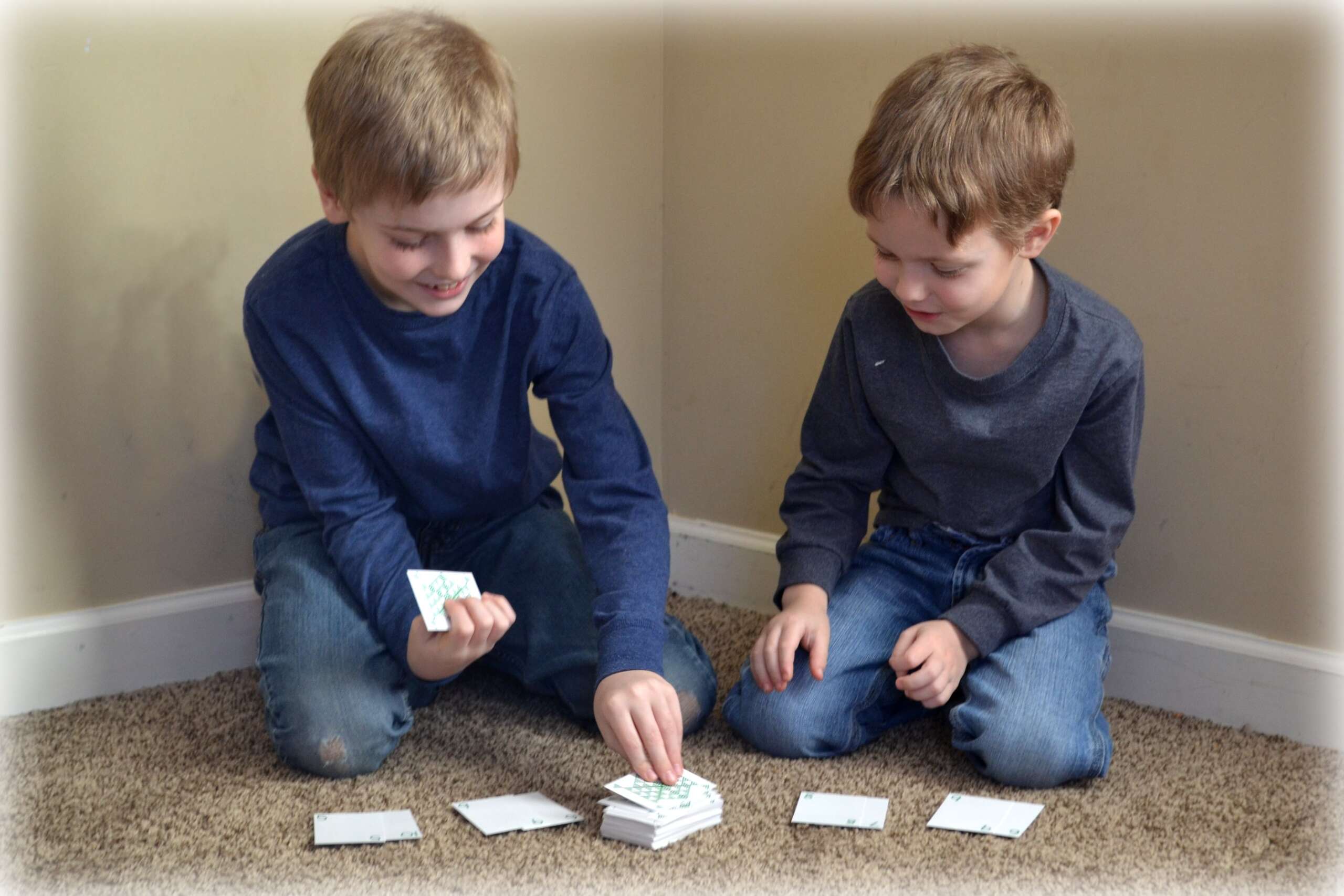
The younger child is learning.
The older child is reinforcing.
When older children explain a strategy, recognize a pattern, calculate an answer, or think through a move, they are strengthening their own mathematical understanding. Explaining mathematics to another requires children to organize their thinking and make relationships clear.
Meanwhile, the younger child gets to see mathematics being used naturally by someone just a little farther along in their learning.
RightStart Math specifically emphasizes that games allow adults and children of different ages and abilities to play together.
And perhaps best of all, nobody has to sit down and announce, “Now we’re going to do this worksheet of math facts.”
They’re just playing a game.
Bring Back the Joy of Math
Children need practice. They need repetition. They need to develop automaticity with important facts.
But they also need to experience mathematics as something they can do, understand, and enjoy.
That is why games are such an important part of RightStart Math.
Games provide an application for newly learned knowledge. They provide the repetition necessary to develop fluency. They create opportunities for conversation and social interaction. They allow older and younger children to learn together.
And, perhaps most importantly, RightStart Math games teach as children play.
The child isn’t simply practicing facts that were already mastered. The child is developing strategies, seeing patterns, applying new knowledge, and building understanding—all while playing.
Because when children associate mathematics with thinking, discovery, laughter, and success, they begin to see math differently.
Math isn’t just something to finish.
Math is something to play.
Ready to Make Math More Fun?
You don’t have to use the entire RightStart Math curriculum to benefit from RightStart Math games. The Math Card Games Kit can supplement any math program and includes everything needed to begin playing: Math Card Games, by Dr. Joan A. Cotter, six special card decks, a Cotter Abacus, and laminated fraction charts. The book includes more than 300 games covering number sense, addition, subtraction, multiplication, division, fractions, money, and clocks.
If you aren’t ready for the complete kit, you can start small with individual game collections. RightStart Math offers collections for areas such as addition, multiplication, Corners™, and fractions, making it easy to choose games that match the skills your child is currently learning. And did you know we even have a Chemistry Card Game kit?
So put away the flash cards. Clear a space at the table. Invite a sibling, a parent, or a friend to play.
And let the learning begin—with a game.